
Spreadsheet numbers go wrong because the file itself has no way to tell you when something has changed, been overwritten, or been copied incorrectly. Unlike a connected system that records every action and flags inconsistencies, a spreadsheet simply displays whatever was last typed into a cell. For dairy traders managing contracts, positions, and deliveries across multiple files, that silent vulnerability compounds quickly. The questions below unpack exactly how it happens and what it means for your trading operation.
What actually makes a spreadsheet number go wrong?
A spreadsheet number goes wrong the moment a formula references the wrong cell, a value is typed manually instead of pulled from a source, or someone pastes data without checking whether the format matches. These are not unusual mistakes. They are the natural consequence of a tool that relies entirely on the person using it to maintain its own logic.
The most common sources of error in trading spreadsheets are not dramatic. A row gets inserted and a sum formula no longer covers the full range. A price gets updated in one tab but not in the three others that reference it. A colleague opens the file at the same time and saves a version that overwrites yours. None of these events produces a warning. The number simply changes, and the file carries on looking perfectly normal.
In dairy ingredient trading, where a single contract can involve multiple delivery windows, currency conversions, and volume tolerances, the number of manual touchpoints in a typical spreadsheet is surprisingly high. Each one is an opportunity for the kind of quiet error that does not announce itself until someone asks a question the file cannot honestly answer.
Why do spreadsheet errors stay hidden for so long?
Spreadsheet errors stay hidden because nobody is looking for them. When a file produces a number, most people treat that number as correct until something external proves otherwise. There is no audit trail, no version history visible at a glance, and no automatic check that compares today’s figures against yesterday’s logic.
In a trading environment, this problem is made worse by the fact that the person who built the spreadsheet and the person reading it are often not the same. The builder understood which cells were fragile and which formulas needed manual updating. The reader simply sees a clean table and assumes it reflects reality.
Errors also stay hidden because they are proportionally small at first. A formula that undercounts by two percent is easy to miss when margins are healthy. It only becomes visible when a customer queries an invoice, a delivery does not match a contract, or someone tries to reconcile the file against an external document and the numbers refuse to align. By that point, the error may have been silently compounding for weeks.
What happens when you can’t trust your trading data?
When you cannot trust your trading data, every decision slows down. Instead of acting on what the numbers say, you spend time verifying them first. You cross-reference files, ask colleagues to confirm figures, and delay responses to customers or suppliers while you chase down the source of a discrepancy.
For dairy ingredient traders, untrusted data creates specific operational risks. Positions become unclear. You may not know with certainty how much of a product you have committed to deliver, what your net exposure is on a contract, or whether a particular customer account is fully invoiced. These are not abstract concerns. They affect cash flow, supplier relationships, and your ability to make confident buying decisions.
There is also a less visible cost. When people stop trusting a system, they build workarounds around it. A second file to double-check the first. A manual tally kept in a notebook. An informal agreement to always call before acting on a number. These workarounds take time, create their own inconsistencies, and signal that the underlying system is no longer fit for purpose even if nobody has said so out loud.
How do dairy traders end up with so many spreadsheets?
Dairy traders end up with many spreadsheets because each new problem gets its own file. It starts with one sheet for contracts. Then a separate one for tracking deliveries, because the contract sheet was getting too cluttered. Then one for open positions, one for customer balances, one for logistics planning. Each file made sense when it was created. Together, they form a system nobody designed and nobody fully understands.
This pattern is not a sign of poor organisation. It is the natural result of using a general-purpose tool to manage a specialised, fast-moving operation. Spreadsheets are flexible enough to handle almost any single task. They are not built to connect those tasks to each other, update automatically when conditions change, or give multiple people a consistent view of the same data at the same time.
In dairy trading specifically, the pace of the market accelerates this fragmentation. Prices move, delivery windows shift, and contract terms get renegotiated. Every change that touches more than one file creates a synchronisation problem. Over time, the files drift apart, and the gap between what the spreadsheets say and what is actually happening in the business quietly widens.
When is a spreadsheet no longer enough for trading operations?
A spreadsheet is no longer enough when more than one person needs to rely on the same data at the same time, when errors are taking longer to find than to fix, or when you are making decisions based on figures you are not fully confident in. For most dairy trading businesses, this point arrives earlier than expected.
Some practical signals that a spreadsheet has reached its limit include:
- Different people are working from different versions of the same file
- Reconciling contracts against invoices requires manual checking across multiple documents
- A new staff member cannot use the system without being trained by the person who built it
- You have experienced at least one error that reached a customer or supplier before it was caught
- You cannot see your current position across all open contracts without building a new summary
The comparison between Excel vs trading software is not really about features. It is about what happens when the volume and complexity of your trading activity exceeds what a static file can reliably track. For smaller dairy trading companies, that threshold is lower than most people expect, because dairy trading is inherently real-time and multi-party in a way that spreadsheets simply were not designed for.
What does a connected trading system do differently?
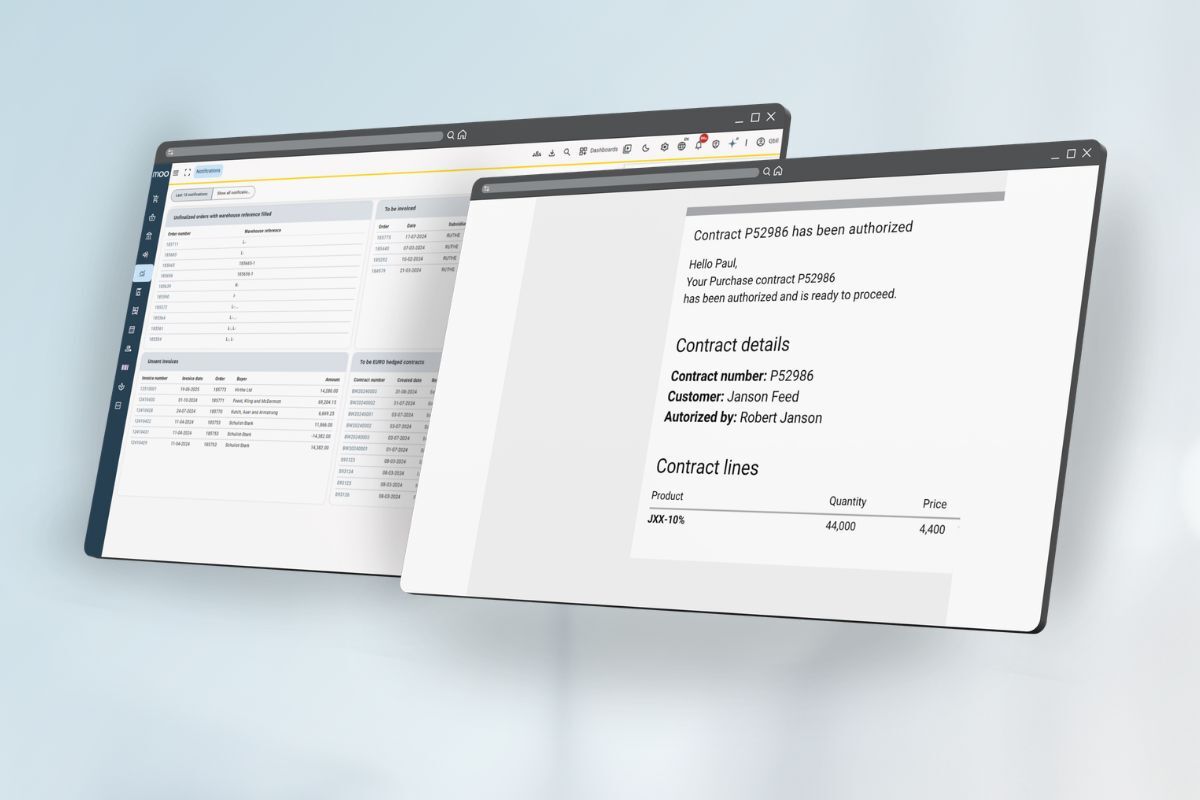
A connected trading system records every action, links every piece of data to its source, and updates all related records automatically when something changes. When a contract is amended, the position overview reflects it immediately. When an invoice is raised, it draws directly from the order and delivery data rather than requiring manual re-entry. There is one version of every number, visible to everyone who needs it.
For dairy ingredient traders, this connectivity matters most in three areas. First, position management: a connected system shows your live exposure across all open contracts without requiring you to build a summary. Second, order and logistics tracking: delivery confirmations update contract fulfilment automatically, so you always know what has been shipped and what remains outstanding. Third, financial reconciliation: because the system links contracts, orders, and invoices, closing out a transaction does not require cross-referencing three separate files.
The shift from spreadsheets to a purpose-built trading system is also faster than most traders expect. Getting your environment set up typically takes a matter of days rather than months, because the system is already structured around the way dairy ingredient trading actually works. You are not configuring a generic tool. You are connecting your operation to a framework that was built for it.
If you have been running your dairy trading business on spreadsheets and are starting to recognise the limits described here, talking to us costs nothing and takes less time than fixing the next formula error that quietly distorts your numbers for a week before anyone notices.
Frequently Asked Questions
How do I know if a spreadsheet error has already affected a customer or supplier relationship?
Start by reconciling your last 30–60 days of invoices against the corresponding contracts and delivery records. If the figures don't align without manual adjustments, an error has likely already propagated outward. Common signs include customers querying invoice amounts, suppliers disputing delivery volumes, or internal figures that can't be explained by anyone currently on the team. Even if no one has raised a complaint, a quiet reconciliation exercise often surfaces discrepancies that have been silently accumulating.
What's the safest way to transition away from spreadsheets without disrupting live trading activity?
The key is to run your new system in parallel with your existing spreadsheets for a short overlap period rather than switching over all at once. Start by migrating your open contracts and current positions first, since these are the records that affect live decisions most directly. Most purpose-built trading platforms — including those designed specifically for dairy ingredient trading — are structured to import existing data and can be operational within days, meaning the disruption window is much shorter than most traders anticipate.
Can't I just add more controls to my existing spreadsheets to make them more reliable?
You can reduce the risk of certain errors by adding input validation, protecting formula cells, and using a single source-of-truth tab that other sheets reference. However, these controls address symptoms rather than the underlying limitation: a spreadsheet still has no audit trail, no real-time multi-user synchronisation, and no automatic consistency checks across files. For low-volume or single-user operations, tighter controls may buy time. For any dairy trading business with multiple people, multiple contracts, and multiple open positions running simultaneously, the structural ceiling of a spreadsheet remains regardless of how carefully it's built.
What data should I prioritise cleaning up before moving to a trading system?
Focus on three categories in order of priority: open contracts with outstanding delivery obligations, current customer and supplier balances, and any positions that directly affect buying or selling decisions you'll make in the next 30 days. Historical data can be migrated or archived separately and doesn't need to be perfect before you go live. Trying to clean everything before switching is one of the most common reasons dairy trading businesses delay a migration longer than necessary — a clean forward-looking dataset is far more valuable than a perfectly reconciled historical one.
How do spreadsheet errors typically affect margin calculations in dairy ingredient trading specifically?
The most common margin errors in dairy trading spreadsheets come from currency conversion rates that aren't updated consistently across files, volume tolerances that are applied manually and inconsistently, and freight or logistics costs that get entered in one file but not reflected in the P&L tab. Because dairy ingredient margins can be tight, even a 1–2% calculation error on a mid-size contract can meaningfully distort your view of which trades are actually profitable. The risk compounds when the same flawed template is copied across multiple contracts without anyone revisiting the underlying logic.
What should I look for when evaluating trading software built specifically for dairy ingredients?
Prioritise systems that handle the specific data structure of dairy trading natively — meaning contracts with multiple delivery windows, volume tolerances, and quality specifications should be first-class fields, not workarounds. Check whether the system links contracts, orders, logistics, and invoicing in a single data model, or whether it's still effectively a set of connected modules that require manual handoffs. Also ask specifically about onboarding time and whether the implementation is measured in days or months — a system genuinely built for dairy ingredient trading should not require a lengthy configuration project before it reflects how your operation actually works.
Is there a point at which it's too early to move to a dedicated trading system — for example, if I'm a smaller dairy trader?
The right threshold isn't really about company size — it's about the number of simultaneous moving parts you're managing. If you're actively tracking more than a handful of open contracts across multiple customers and suppliers, dealing with multi-window delivery schedules, or have more than one person who needs to act on the same data, the structural limitations of spreadsheets are already present regardless of your trading volume. Smaller dairy trading operations often benefit most from making the switch early, before the spreadsheet complexity has grown to a point where the migration itself becomes a significant project.