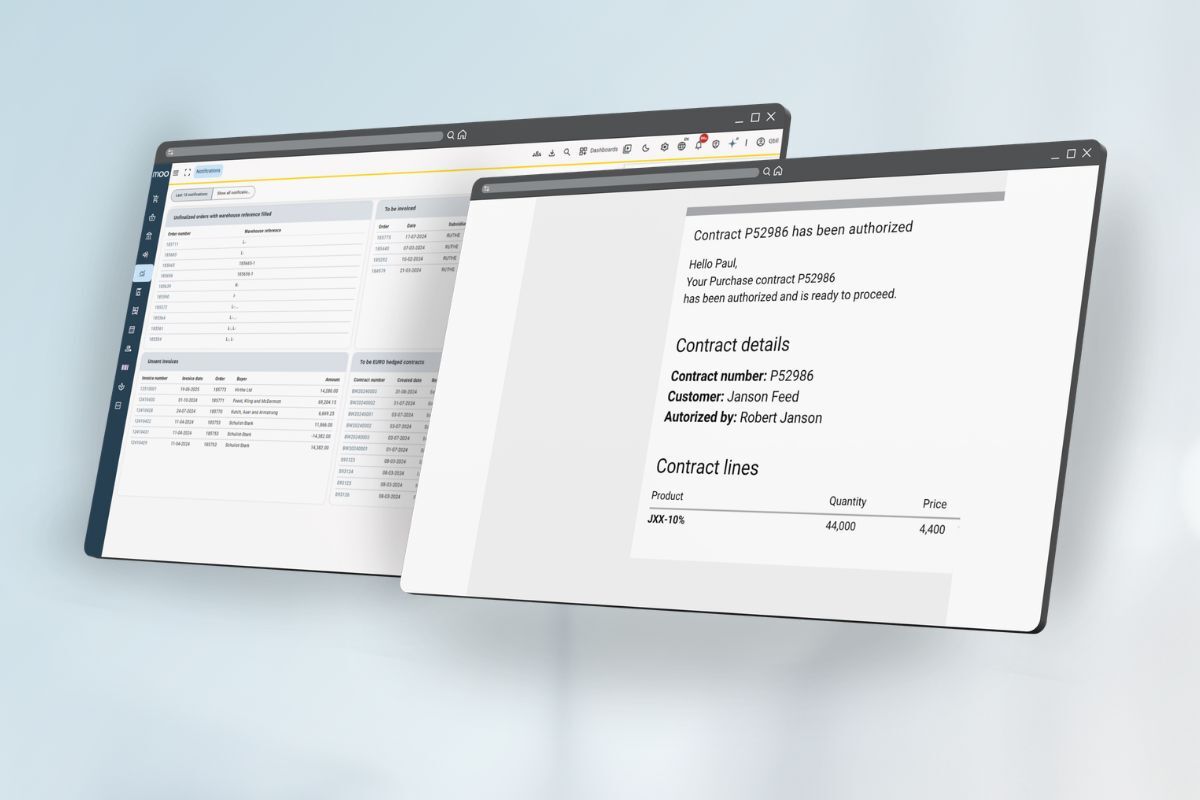

You can manage logistics and contracts in one place by using a single connected system where every contract automatically links to its corresponding orders, shipments, and delivery status. For dairy ingredient traders, this means no more switching between files, inboxes, and folders to find out where a shipment stands or what a contract actually commits you to. The questions below unpack why these two things keep drifting apart and what it takes to bring them together.
Why do logistics and contracts keep ending up in separate places?
Logistics and contracts end up in separate places because they are typically handled by different people at different moments in the trading process. Contracts are agreed upfront, often in email threads or spreadsheets, while logistics are coordinated later, usually through separate messages, phone calls, or a different file entirely. Without a shared system, the two streams never naturally connect.
In dairy ingredient trading, this split happens quickly and quietly. A contract is negotiated, saved somewhere, and then handed off to whoever handles shipping. That person works from their own records. The original contract terms, delivery windows, quantities, and pricing stay in one place while the actual movement of goods is tracked somewhere else entirely. Over time, the gap between what was agreed and what is actually happening becomes harder to see.
The deeper reason this persists is that most small trading businesses build their processes around the tools they already have. Email is familiar. Spreadsheets are flexible. And for a while, they work. The problem is not that these tools are wrong in principle. It is that they were never designed to keep two separate data streams synchronized in real time, especially when multiple people are working across them at the same time.
What problems does disconnected contract and logistics data actually cause?
Disconnected contract and logistics data cause delayed decisions, missed delivery windows, and contract errors that are often discovered too late to fix without cost. When the people managing logistics cannot instantly see what the contract requires, and the people managing contracts cannot see what logistics has actually confirmed, mistakes become almost inevitable over time.
Some of the most common problems that surface in this kind of setup include:
- Quantities shipped that do not match what was contracted, only noticed at invoicing
- Delivery dates missed because the logistics team was working from an outdated version of the contract
- Disputes with customers or suppliers that take days to resolve because nobody has a clear audit trail
- Invoices sent with incorrect pricing because the final contract terms were never updated in the billing file
- Time spent every week manually cross-checking files that should already agree with each other
The silent version of this problem is worse. A copied formula in a spreadsheet, a file saved under the wrong name, a contract amendment that never made it into the logistics notes. These are the errors that do not announce themselves. They sit quietly in the background, distorting your picture of what is actually happening until something breaks visibly, a customer complaint, a financial discrepancy, or a delivery that simply does not arrive.
How does a connected system link contracts to logistics in real time?
A connected system links contracts to logistics in real time by making every contract the source of truth for all downstream activity. When a contract is created or updated, the related orders, delivery schedules, and position data update automatically. Nobody has to manually transfer information from one place to another, because the information only exists in one place to begin with.
In practice, this means that when a contract is agreed, it immediately generates the corresponding order records. Logistics planning draws directly from those records, so the delivery team always works from the current contract terms. When a shipment is confirmed or a delivery date changes, that update flows back to the contract view, so the trader can see the live status of every open position without chasing anyone for an update.
This kind of real-time connection also changes how position management works. Instead of manually calculating your exposure across open contracts at the end of the week, a connected system shows you your current position continuously. You can see at a glance what is contracted, what is in transit, what has been delivered, and what is still open. That level of visibility is simply not achievable when contracts and logistics live in different files.
Il nostro software per il commercio di latticini is built around exactly this principle. Contracts, orders, logistics, and financials are all connected within a single environment, so the data you need is always current and always in one place.
What’s the difference between a generic ERP and a trade-specific system?
The key difference between a generic ERP and a trade-specific system is that a generic ERP is built to cover a wide range of industries and has to be heavily configured before it fits how trading actually works, while a trade-specific system is built around the workflows, terminology, and data structures that traders use every day from the start.
Generic ERP platforms are powerful, but that power comes with complexity. They are designed to handle manufacturing, retail, services, and dozens of other business types. To make them work for dairy ingredient trading, you typically need to build custom fields, adapt standard workflows, and train your team to work around the parts of the system that do not quite fit. That process takes time, costs money, and often results in a system that still does not feel natural to the people using it.
A trade-specific system, by contrast, already understands concepts like contract positions, commodity pricing, delivery tolerances, and multi-currency transactions. The language of the system matches the language of the trade. You do not need to explain to the software what a forward contract is or how a partial shipment affects your open position. It already knows.
For smaller dairy trading businesses in particular, this distinction matters enormously. A generic ERP implementation can stretch across months and require dedicated IT resources. A system built for your trade can be operational in days, because the foundational logic is already there.
When is the right time to move away from spreadsheets?
The right time to move away from spreadsheets is when the cost of maintaining them, in time, errors, and missed decisions, exceeds the effort of switching to something better. For most dairy ingredient traders, that point arrives earlier than they expect, usually when a second or third person starts working in the same files, or when the number of open contracts grows beyond what one person can hold in their head.
There are some clear signals that the tipping point has been reached:
- You or a colleague spend significant time each week reconciling files rather than trading
- You have had at least one contract error or missed delivery that traced back to outdated information
- New team members struggle to understand which file is current and which version to trust
- You cannot quickly answer a basic question like what your open position is on a specific product without digging through multiple files
- Your business has grown to the point where the risk of a single spreadsheet error has real financial consequences
The comparison between Excel vs trading software is not really about features. It is about what happens when things go wrong. Spreadsheets do not prevent errors. They just record them, silently, until someone notices. Structured software builds checks and connections into the process itself, so the class of quiet, compounding mistakes that spreadsheets allow simply cannot occur in the same way.
If you recognize your current situation in any of those signals, the question is not whether to move. It is how quickly you can do it without disrupting your operations.
How quickly can a dairy trading business get up and running?
A dairy trading business can typically be fully operational on a purpose-built trading system within a matter of days, not weeks or months. Unlike large ERP implementations that require extensive configuration and training, a system designed specifically for dairy ingredient trading comes with the core logic already in place, which dramatically reduces setup time.
The reason speed is possible here comes back to the trade-specific design principle. When the system already understands how dairy trading works, there is far less to configure before it becomes useful. You are not starting from a blank platform and building your workflows from scratch. You are stepping into an environment that already reflects how your business operates.
Il nostro onboarding and implementation process is designed to get your environment fully operational within two days. That includes your contracts, orders, logistics, and financial connections set up and ready to use. For a business that has been managing everything in spreadsheets, the shift is often described as immediately visible rather than something that takes months to feel.
If you are at the point where you want to see what this looks like for your specific trading operation, the most direct next step is to get in touch and talk through what you need. There is no lengthy sales process, just a practical conversation about whether the fit is right.
Domande Frequenti
Can I migrate my existing contracts and logistics data from spreadsheets into a new system without losing anything?
Yes, and this is typically one of the first things to plan for before switching. Most purpose-built trading systems support data import from spreadsheets, so your existing contracts, open positions, and logistics records can be brought across rather than re-entered manually. The key is to do a data audit before migrating — identify which version of each file is current, consolidate any duplicates, and flag open contracts that need to be active from day one. A good onboarding process will walk you through exactly this, so nothing falls through the cracks during the transition.
What happens to contract visibility when multiple team members are working on deals at the same time?
In a connected system, every user works from the same live data, so there is no risk of two people editing different versions of the same contract simultaneously. Changes made by one team member — whether that is updating a delivery date, confirming a shipment, or amending a quantity — are immediately visible to everyone else. This eliminates the version-control problem that makes shared spreadsheets so unreliable, and it means your whole team always has the same picture of what is open, what is in transit, and what has been settled.
How do I handle partial shipments or contract amendments without creating data inconsistencies?
This is one of the areas where a trade-specific system has a clear advantage over spreadsheets. When a partial shipment is confirmed, the system automatically updates the remaining open quantity on the contract rather than requiring you to manually adjust figures across multiple files. Contract amendments work the same way — the updated terms flow through to the related orders and logistics records in real time, so there is never a situation where your shipping team is working from superseded contract conditions. Every change leaves a clear audit trail, which is also invaluable if a dispute arises later.
Is a connected trading system secure enough to store sensitive contract and pricing data?
Purpose-built trading platforms are designed with data security as a core requirement, not an afterthought, because they are built specifically for businesses handling commercially sensitive pricing, supplier relationships, and financial positions. Look for systems that offer role-based access controls, so team members only see the data relevant to their role, as well as encrypted data storage and regular backups. Before committing to any platform, it is worth asking the provider directly about their security certifications, data residency policies, and what happens to your data if you ever decide to leave.
What if my trading operation involves multiple currencies or cross-border shipments — can a trade-specific system handle that?
Yes, and this is one of the practical limitations of managing international dairy ingredient trading in spreadsheets. A trade-specific system is built to handle multi-currency contracts, exchange rate fluctuations, and the logistics complexity that comes with cross-border shipments as standard features, not add-ons that need to be configured from scratch. This means your position calculations, invoicing, and financial reporting all account for currency correctly without requiring manual conversion steps that introduce rounding errors or outdated rates.
How do I make the case internally for switching systems when the current setup 'mostly works'?
The strongest internal case is usually a cost-of-errors argument rather than a features argument. Track how many hours per week your team spends reconciling files, chasing updates, or correcting mistakes — then put a number on what that time costs. Add to that any contract errors, missed deliveries, or billing discrepancies from the past year and estimate their financial impact. In most cases, the hidden cost of a 'mostly working' spreadsheet setup significantly exceeds the cost of switching, especially once you factor in the risk of a single serious error at scale. Presenting that calculation to decision-makers tends to shift the conversation from 'why change?' to 'why haven't we changed already?'
What should I look for when evaluating whether a trading system is genuinely built for dairy ingredient trading versus just marketed that way?
The clearest test is whether the system's native terminology and default workflows match how you actually trade. A genuinely trade-specific platform will use concepts like contract positions, delivery tolerances, commodity-based pricing, and partial fulfilment out of the box — without requiring you to relabel generic fields or build workarounds. Ask for a live demo using a real scenario from your own trading operation, such as a forward contract with a partial shipment and a price amendment, and watch whether the system handles it naturally or whether the demonstrator has to explain how to make it fit. That gap between native capability and workaround tells you everything.