
Dairy businesses struggle with scattered data because the work itself is fragmented by nature. Contracts, logistics, pricing, and invoicing each generate their own records, and without a single connected system, that information ends up spread across spreadsheets, email threads, and shared drives. The result is a business where everyone is technically working from data, but nobody is fully confident in it. The sections below unpack why this happens, what it costs, and what a better setup actually looks like.
What makes dairy trading data so hard to keep in one place?
Dairy trading data is hard to centralize because every stage of a trade generates different information at different times, owned by different people. A contract gets agreed over email, a delivery gets logged in a spreadsheet, an invoice goes into an accounting tool, and a price update arrives by phone. Each piece exists, but nothing connects them automatically.
The deeper problem is that dairy trading moves fast. Prices shift, delivery windows change, and counterparties need quick confirmation. When your data lives in separate files and inboxes, keeping everything current becomes a full-time job in itself. Someone is always chasing the latest version of a document or cross-checking a figure that should already be visible.
Most smaller dairy trading businesses did not start out this way by choice. They started with one spreadsheet that worked perfectly when there were five contracts a month. Then the business grew, a second person started adding data, a third joined and built their own file, and suddenly there are six versions of the same position overview with no clear authority on which one is right. This is not a discipline problem. It is a structural one: spreadsheets are static by design, and dairy trading is not.
What are the most common signs your data is too scattered?
The clearest signs that your data has become too scattered are that you cannot answer a basic question about your current position without opening multiple files, that different people in your business give different answers to the same question, and that you only discover a problem after it has already caused consequences.
In practice, these signs tend to show up in recognizable patterns:
- You prepare for a customer call by pulling together figures from at least two or three places before you feel ready to speak
- A colleague updates a contract detail but the change does not reach everyone who needs it
- You find a formula error in a spreadsheet that has been quietly producing wrong totals for weeks
- Someone leaves the business and takes critical context with them because it was never recorded anywhere formal
- Month-end reconciliation takes longer than it should because the numbers from operations and finance do not match on the first attempt
These are not signs of carelessness. They are signs that the tools being used were never designed for a multi-person, real-time operation. Recognizing them is the first step toward understanding that the problem has a name and, importantly, a solution.
How does scattered data lead to costly mistakes in dairy contracts?
Scattered data leads to costly mistakes in dairy contracts because contract management depends on timing, precision, and shared visibility. When the details of a contract live in one person’s inbox or a local spreadsheet, the risk of a missed deadline, a wrong quantity, or an unmatched price is not a matter of if but when.
Dairy contracts are not forgiving documents. A delivery window missed by a day can mean a penalty. A quantity discrepancy between what was contracted and what was invoiced creates disputes that take time and goodwill to resolve. A price that was verbally updated but never formally recorded can cost real margin when it surfaces at settlement.
The most dangerous mistakes are the silent ones. A copied formula that calculates the wrong tonnage, a contract term that was updated in one file but not in the version someone else is working from, a shipment that goes out without anyone noticing the payment terms had changed. These errors do not announce themselves. They surface later, often at the worst possible moment, and by then the cost is already locked in.
When contract data is connected to orders, logistics, and invoicing in one place, these gaps close. The contract becomes the source of truth that everything else flows from, rather than one document among many that may or may not reflect current reality.
Why do dairy traders keep using spreadsheets despite the risks?
Dairy traders keep using spreadsheets despite the risks because spreadsheets feel familiar, flexible, and free. They require no onboarding, no vendor relationship, and no explanation to a colleague. When a business is small and a single person holds most of the knowledge, a spreadsheet can genuinely work well enough that the risks stay invisible.
There is also a deeper reason: most dairy traders have never seen a realistic alternative designed specifically for their type of work. Generic ERP systems are expensive, complex, and built for manufacturing or retail logic that does not map cleanly onto commodity trading. When the only visible options are a system that is too big and a spreadsheet that is too small, most people stay with what they know.
The mindset that keeps spreadsheets in place is often “this is just how our industry works.” And for a long time, it was. But the industry has changed. Trading volumes have grown, supply chains have become more international, and customer expectations around speed and accuracy have risen. The spreadsheet that worked in 2015 is carrying a heavier load in 2026, and the cracks show up as errors, delays, and stress rather than as a clear signal that the tool itself is the problem.
Understanding that purpose-built software per il commercio di latticini exists, and that it does not require a large IT project to implement, changes the calculation entirely. The comparison is no longer between a familiar tool and an unknown risk. It becomes a practical question about what a connected system would actually make easier.
What does a connected data system look like for dairy trading?
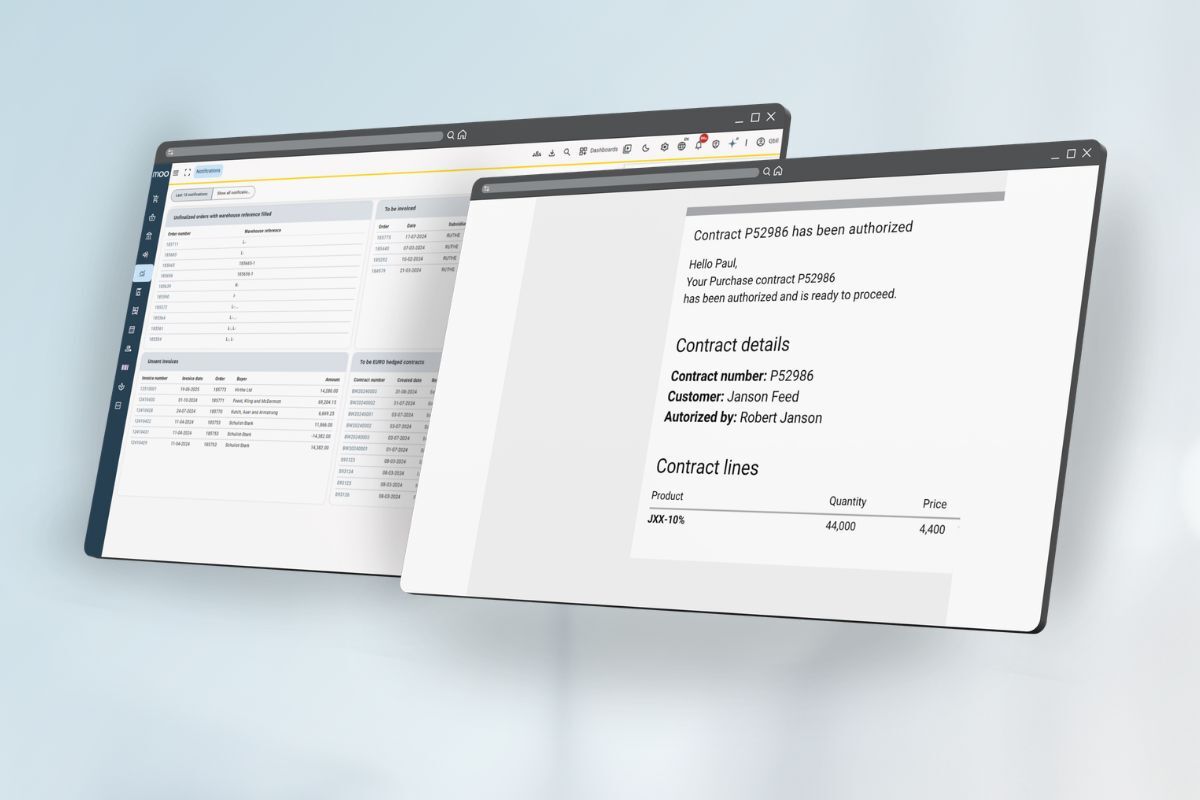
A connected data system for dairy trading is one where contracts, orders, logistics, inventory, and invoicing all live in the same environment and update each other automatically. When a contract is confirmed, it feeds into position management. When a delivery is logged, it updates the inventory. When an invoice is generated, it pulls from the original contract terms rather than requiring manual re-entry.
The practical difference this makes is that everyone in the business is working from the same current picture. A salesperson can check available stock before confirming a deal. A logistics coordinator can see which contracts are approaching delivery without asking someone else to pull the data. A director can look at the open position across all active contracts without waiting for a weekly summary.
For dairy ingredient traders specifically, this kind of visibility matters because margins are tight and timing is everything. Knowing your exact exposure on a contract, what is in transit, and what is due for invoicing is not a luxury. It is the basic information needed to make good decisions quickly.
A connected system also reduces the class of silent errors that spreadsheets are prone to. When data flows through structured workflows rather than being manually copied between files, the opportunity for a formula error or a missed update to quietly distort results is dramatically reduced. The system does not replace judgment, but it removes the noise that gets in the way of it.
If you are curious about what this looks like in practice for a business like yours, we are happy to walk you through it.
Domande Frequenti
How long does it typically take to migrate from spreadsheets to a connected dairy trading system?
For most small to mid-sized dairy trading businesses, the migration process is significantly shorter than people expect — often a matter of weeks rather than months. Purpose-built dairy trading platforms are designed to import existing data from spreadsheets and map it to structured workflows without requiring a large IT project. The key is starting with your active contracts and current positions, then bringing in historical data progressively rather than trying to move everything at once.
What if my team is resistant to changing the way we currently manage data?
Resistance usually comes from two places: familiarity with existing tools and fear of disruption during a busy trading period. The most effective way to address this is to involve the people who use the data daily in the evaluation process, so they can see firsthand how a connected system removes the frustrations they already deal with — like chasing updated figures or reconciling mismatched numbers. Starting with a focused pilot on one part of the workflow, such as contract management, can also build confidence before a full rollout.
Can a connected system handle the informal ways dairy trading actually happens, like deals agreed over the phone or by WhatsApp?
Yes — and this is one of the most important things to get right. A good dairy trading system does not require every deal to originate inside the platform; it needs to make it fast and easy to record a deal the moment it is agreed, regardless of how it was communicated. The discipline shift is small: instead of jotting a deal in a notebook or sending yourself an email, you log it directly into the system. The payoff is that from that moment, the contract is live, visible, and connected to everything downstream.
How do we know which data to prioritize fixing first if our current setup is already quite messy?
Start with the data that directly affects money and decisions: open contracts, current inventory positions, and outstanding invoices. These three areas carry the highest risk when inaccurate and deliver the most immediate value when cleaned up and centralized. Historical data and secondary records can be tidied up over time, but getting your live trading position accurate from day one is what will make the difference in day-to-day operations.
Does moving to a connected system mean we need to change how we work with our logistics partners or counterparties?
Not necessarily. A connected system primarily changes how your internal team captures, shares, and acts on data — your external relationships and communication channels do not need to change unless you want them to. Over time, some businesses do choose to share structured data or documentation with key partners directly through their platform, but this is an optional step, not a requirement for getting the core benefits of centralized data management.
What are the biggest mistakes businesses make when trying to fix their data problems in-house?
The most common mistake is trying to solve a structural problem with more spreadsheets — building a more elaborate master file, adding more validation rules, or assigning one person to manually consolidate data from everyone else. This buys time but does not fix the underlying issue, and it often adds a single point of failure. The second most common mistake is delaying action until a major error forces the issue, by which point the cost of the problem is already real.
How do we evaluate whether a dairy trading platform is actually built for our type of business, rather than just a generic system rebranded?
Ask specific questions about the workflows that matter most to you: How does the system handle a contract amendment mid-delivery? Can it track multiple price components — such as base price, premiums, and FX — on a single contract line? Does it natively manage the difference between contracted volume and invoiced volume? A platform built for dairy trading will answer these questions with specificity and show you exactly where those scenarios live in the product, rather than explaining how you could configure a workaround.