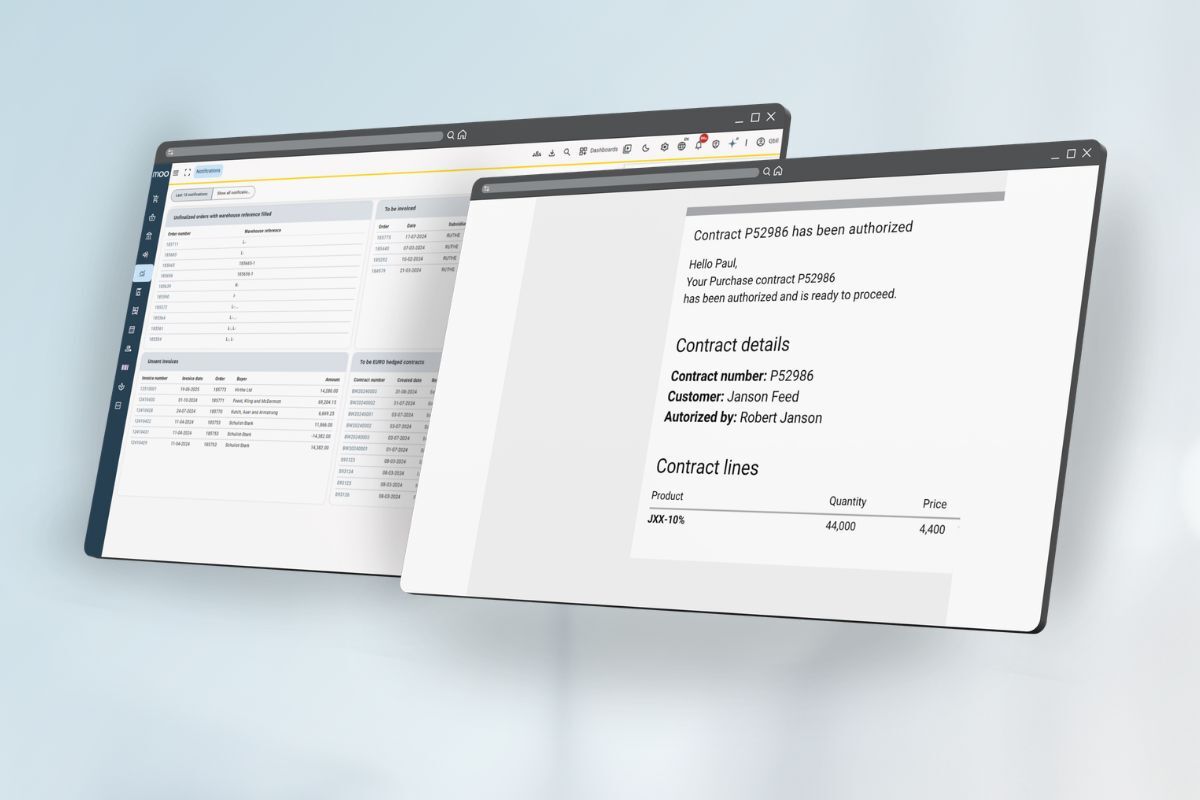

You can manage milk powder and butter contracts efficiently by centralizing all contract data in one place, tracking open positions in real time, and connecting contracts directly to orders, logistics, and invoicing. For dairy ingredient traders handling multiple counterparties and shipment windows, the key is eliminating the gap between what was agreed and what is actually being executed.
Most dairy trading businesses start with spreadsheets and email threads, and that works fine at low volume. The moment you are managing several open contracts simultaneously across different product types and delivery dates, the cracks appear quickly. The questions below unpack exactly where those cracks form and what you can do about them.
What makes dairy commodity contracts harder to manage than other trades?
Dairy commodity contracts are harder to manage than most other trades because the product itself is highly time-sensitive, quality-dependent, and subject to rapid price movement. A contract for milk powder or butter is rarely a simple buy-sell agreement. It involves specific fat and protein specifications, packaging requirements, shelf life windows, loading periods, and often price formulas tied to market indices rather than fixed numbers.
Unlike, say, a contract for industrial components, a dairy contract can be affected by seasonal supply fluctuations, cold chain logistics constraints, and regulatory requirements that vary by destination country. This means a single contract can generate a cascade of operational tasks: booking transport, arranging inspections, coordinating with a warehouse, issuing a certificate of origin, and matching all of that back to the original agreed terms.
The other complicating factor is that dairy ingredient traders often work with rolling positions. You may be selling forward before you have confirmed supply, or buying speculatively based on price outlook. That makes it essential to know at any moment exactly what you are committed to, what is still open, and where your exposure sits. That level of visibility is difficult to maintain when contract data lives across multiple files and inboxes.
How do traders typically track open positions across multiple contracts?
Most dairy ingredient traders track open positions using a combination of spreadsheets, email folders, and memory. A position sheet in Excel lists outstanding buy and sell contracts, and someone manually updates it as shipments go out or deliveries come in. This approach works when the number of open contracts is small and one person holds all the context.
The problem with manual position tracking is that it is only as accurate as the last person who updated the file. If a partial shipment goes out on a Friday afternoon and the spreadsheet does not get updated until Monday, your position view is wrong for the entire weekend. In fast-moving markets, that lag matters.
More structured trading operations use a position register that links directly to contract records, so that every order booked, every delivery confirmed, and every invoice raised automatically adjusts the open position. This is the core of what purpose-built software per il commercio di latticini does: it keeps your position view current without requiring manual reconciliation between separate files.
What information should a dairy trade contract always include?
A dairy trade contract should always include the product specification, quantity, price or pricing mechanism, delivery terms, loading or shipment period, payment terms, and the applicable quality standards or certifications. Missing any one of these creates ambiguity that typically surfaces at the worst possible moment, usually when a dispute arises or a delivery is rejected.
Beyond the basics, experienced dairy traders also make sure contracts specify:
- Packaging and labeling requirements, including bag size, pallet configuration, and any private label instructions
- Shelf life at the time of shipment, which is especially critical for milk powder and whey derivatives
- Tolerance bands on quantity, since bulk dairy shipments rarely arrive at exactly the contracted weight
- Inspection and sampling rights, including who bears the cost of third-party testing
- Force majeure and default provisions, which become relevant during supply disruptions
One practical discipline is to treat the contract as the single source of truth that every downstream action, order, logistics booking, and invoice must trace back to. When that link is maintained consistently, errors are caught early rather than discovered at the invoicing stage.
What’s the difference between managing butter and milk powder contracts?
The key difference between managing butter and milk powder contracts is that butter is more sensitive to storage and temperature conditions, while milk powder contracts tend to involve more complex specification management across fat, protein, and moisture content. Both require careful position tracking, but the operational risks and the points where errors typically occur are different.
Butter contract considerations
Butter is a perishable product with strict cold chain requirements. Contracts for butter need to account for storage location and conditions, because the quality, and therefore the value, of the product can degrade if logistics are mismanaged. Shelf life tracking is more urgent, and the logistics coordination between contract and delivery is tighter. Traders also need to be aware of the distinction between different grades and fat contents, which vary by region and buyer specification.
Milk powder contract considerations
Milk powder contracts typically involve more specification variables. Whole milk powder, skimmed milk powder, and various functional powders each carry different analytical requirements. Buyers in different markets, particularly in Asia and the Middle East, often have precise specifications around solubility, heat treatment, and microbiological standards. Managing these contracts means tracking not just quantity and price but which specification applies to which lot, and ensuring documentation like certificates of analysis are matched to the right shipment.
In practice, the difference means that a trader handling both product types needs a system that can track product-specific attributes at the contract level, not just generic quantity and price fields.
How do you avoid errors when contracts move from order to invoice?
You avoid errors when contracts move from order to invoice by ensuring that every step in the process, from booking the order to confirming delivery to raising the invoice, draws from the same underlying contract record rather than being re-entered manually. The majority of invoicing errors in dairy trading come from data being retyped at each stage, which introduces transcription mistakes and version mismatches.
The most common failure points in the order-to-invoice process are:
- Price discrepancies when an invoice is raised from memory or a separate price list rather than the agreed contract terms
- Quantity mismatches when the invoiced weight differs from the actual delivered weight and no tolerance or adjustment process is in place
- Wrong payment terms when the invoice reflects standard terms rather than the specific terms negotiated for that contract
- Missing documentation such as a certificate of origin or analysis that the buyer requires before releasing payment
Building a connected workflow, where the order is created from the contract, the delivery is confirmed against the order, and the invoice is generated from the confirmed delivery, eliminates most of these errors structurally. You are not relying on anyone to remember or re-enter the right details at each step.
When should a dairy trading business replace spreadsheets with dedicated software?
A dairy trading business should replace spreadsheets with dedicated software when the cost of a single error, whether a missed delivery, a contract dispute, or an invoicing mistake, exceeds the effort of switching systems. For most businesses, that threshold arrives earlier than expected, often somewhere between five and fifteen open contracts running simultaneously, or when more than one person needs to work with the same data.
Il Excel vs trading software question is not really about features. It is about whether your current setup can give you an accurate answer to basic operational questions in real time. Can you tell right now what your open position is across all active contracts? Can you see which shipments are overdue? Can you pull up the exact terms of a contract from three months ago without searching through email? If the answer to any of those is “not immediately,” the operational risk is already present.
The practical signals that spreadsheets are no longer sufficient include:
- More than one person editing the same file, leading to version conflicts
- Errors that go unnoticed for days or weeks because no one has a complete view
- Time spent reconciling data between files rather than trading
- Difficulty onboarding new staff because the system only makes sense to the person who built it
- A near-miss or actual error that caused a financial or relationship cost
The good news is that switching does not have to be a large, disruptive project. We built Moo Software specifically for dairy ingredient traders who want to move from fragmented systems to a single connected environment without a months-long implementation. If you want to understand what that looks like for your specific setup, get in touch and we can walk you through it.
Domande Frequenti
Can dairy trading software integrate with our existing ERP or accounting system?
Most purpose-built dairy trading platforms are designed with integration in mind and can connect to common accounting tools like Xero, QuickBooks, or larger ERP systems via API or data export. The key question to ask any vendor is whether the integration is bidirectional — meaning contract and invoice data flows both ways — or just a one-way export. A proper integration eliminates the need to re-enter financial data and keeps your trading records and accounts in sync without manual effort.
How do we handle price formula contracts where the final price is only known at shipment?
Price formula contracts, where the final price is tied to an index like GDT, Euronext, or a published market reference, require your system to hold the formula logic separately from the final price and calculate the invoice value once the pricing period closes. In a spreadsheet environment, this typically means maintaining a separate pricing workbook and manually updating contracts when the reference price is confirmed, which is a common source of invoicing errors. Dedicated dairy trading software handles this by storing the formula at the contract level and applying the confirmed market price automatically when it becomes available, so the invoice always reflects the agreed mechanism rather than a manually entered number.
What's the best way to manage contracts with multiple partial shipments or delivery windows?
Contracts with multiple shipment tranches should be structured so that each partial delivery is tracked against the original contracted quantity, with the remaining open balance updating automatically after each shipment is confirmed. The most practical approach is to create individual shipment records linked to the parent contract, rather than duplicating the contract or managing tranches in separate rows of a spreadsheet. This way, you always have a clear view of what has shipped, what is still outstanding, and whether any delivery window is at risk of being missed — without having to manually calculate the balance each time.
How should we handle a situation where a buyer rejects a shipment due to a specification dispute?
A specification dispute is much easier to resolve when the contract clearly documents the agreed spec, the certificate of analysis from the shipment is on file, and both documents are linked to the same trade record. The first step is to compare the shipment's certificate of analysis against the contracted specification to determine whether the product genuinely fell outside tolerance or whether the rejection is based on a misunderstanding. Having that documentation centralized and readily accessible — rather than scattered across emails — means you can respond quickly and with evidence, which significantly strengthens your position in any negotiation or formal dispute process.
Is it worth standardizing contract templates, and how do we get counterparties to accept them?
Standardizing your contract templates is one of the highest-return operational improvements a dairy trading business can make, because it reduces the time spent reviewing and negotiating terms on every deal and makes your contracts easier to manage systematically. The most effective approach is to develop a base template that covers your core requirements — specifications, tolerances, shelf life, payment terms, and documentation — and then negotiate counterparty-specific variations as named exceptions rather than starting from scratch each time. Most buyers and sellers are receptive to a well-structured template, especially if it is clearly written and fair; resistance usually comes from templates that are one-sided or overly complex.
How do we manage contract risk when buying speculatively without confirmed end buyers?
Speculative or back-to-back trading positions require especially tight position visibility, because the window between buying and selling can expose you to price movement, quality degradation, or storage costs that erode your margin. The key discipline is to set clear internal limits on how much open speculative exposure you are comfortable carrying at any one time, and to review your position daily rather than weekly. Using a system that shows your net position across all open contracts — not just the buy side or the sell side in isolation — makes it much easier to spot when your exposure is drifting beyond your intended risk parameters before it becomes a problem.
What documentation should we keep on file after a dairy trade contract is fully executed?
Once a contract is fully executed, you should retain the signed contract, all amendments or addenda, the commercial invoice, the bill of lading or transport document, the certificate of analysis, the certificate of origin, any inspection reports, and proof of payment. Regulatory requirements and buyer agreements often specify minimum retention periods, but as a practical rule, keeping full trade documentation for at least five to seven years is a sensible baseline for most dairy ingredient businesses. Storing these documents linked directly to the trade record — rather than in a general file folder — means you can reconstruct the full history of any contract quickly if a dispute, audit, or customs query arises months or years later.