
When a key employee leaves your dairy trading business, their knowledge often leaves with them. The contracts they managed, the supplier relationships they maintained, the workarounds they built into your spreadsheets — none of that is automatically documented anywhere. For small trading operations running on Excel and email, a single departure can quietly destabilize months of operational continuity.
This is one of the most underestimated risks in ingredient trading, and it tends to surface at the worst possible moment. The sections below break down exactly where that risk lives, what it costs you, and what you can do about it before someone hands in their notice.
Where does critical trading knowledge actually live?
In most small dairy trading businesses, critical knowledge lives in three places: inside people’s heads, inside files only they maintain, and inside email threads only they have access to. None of these are systems. They are habits — and habits disappear when the person who formed them walks out the door.
Think about the person on your team who manages supplier relationships. They know which contacts to call when a shipment is delayed. They know which counterparties prefer a certain tone in negotiations. They know the informal agreements that never made it into a formal contract. That knowledge is real and it drives results, but it exists nowhere in writing.
The same applies to your operational files. One person builds the pricing sheet. Another maintains the delivery tracker. A third keeps the position overview updated. Each file makes sense to the person who built it. To everyone else, it is a locked room without a key.
What kind of data is most at risk when someone leaves?
The data most at risk when a key employee leaves is the data that was never formally recorded: open contract positions, pending logistics arrangements, verbal commitments with buyers or suppliers, and the logic behind formulas in shared spreadsheets. This is not the data you can recover from a backup. It is the data that only existed in one person’s working memory.
Beyond undocumented knowledge, there are several categories of structured data that become dangerously unreliable after a departure:
- Contract status and open positions — Who knows which contracts are fully executed, which are partially fulfilled, and which are still being negotiated?
- Logistics arrangements — Pending bookings, agreed delivery windows, and carrier preferences often live in one person’s inbox.
- Pricing history and margin calculations — Spreadsheet formulas built by one person rarely come with documentation. A wrong assumption about how a cell was calculated can lead to real pricing errors.
- Supplier and customer context — Payment terms, preferred communication methods, and relationship history are rarely stored in a central place.
- Workarounds and manual adjustments — Every operation has them. The person who built them is usually the only one who knows they exist.
How long does it take to recover lost operational knowledge?
Recovering lost operational knowledge after a key employee leaves typically takes several weeks to several months, depending on how much was documented before they left. In trading businesses where processes live in spreadsheets and email, full recovery is sometimes never achieved — the knowledge is simply rebuilt from scratch through trial and error.
The immediate impact is usually visible within the first week. Colleagues start asking questions that used to have obvious answers. Files that seemed self-explanatory turn out to be confusing. Customers or suppliers follow up on things nobody internally has context for.
The slower damage is harder to see. Incorrect assumptions get baked into new processes. Spreadsheets get rebuilt with slightly different logic. Relationships that were carefully maintained start to drift. None of this shows up as a single obvious failure — it shows up as a gradual decline in accuracy and responsiveness that is easy to attribute to other causes.
The recovery timeline also depends heavily on how much overlap there was between the departing employee and whoever takes over. A rushed handover of two or three days rarely captures more than the surface layer of what someone actually knew.
Why do spreadsheets make this problem worse?
Spreadsheets make knowledge loss worse because they are personal tools masquerading as shared systems. When someone builds a trading tracker or a contract overview in Excel, they are encoding their own logic, their own assumptions, and their own shortcuts into a file that has no way of explaining itself to anyone else. The file looks like data, but it is actually a record of how one person thinks.
This is the core of the Excel vs trading software debate that many small dairy businesses never realize they are having. Excel is not wrong — it is just designed for individual use. It does not enforce consistent data entry. It does not flag when a formula has been overwritten. It does not tell you who changed what, or when, or why.
In a trading environment, that creates compounding risk. One person leaves and takes their file logic with them. Their replacement builds a new file with slightly different logic. Over time, the business is running on a patchwork of overlapping spreadsheets that nobody fully understands. When something goes wrong — a missed delivery, a contract dispute, a pricing error — tracing the source back through multiple file versions is an enormous task.
There is also the version problem. When files are shared over email or stored on a local drive, there is no guarantee that the version someone is working from is the current one. Decisions get made on outdated data. That is not a people problem. It is a structural problem built into how spreadsheets work.
What should a dairy trading business do before a key person leaves?
Before a key person leaves, a dairy trading business should focus on three things: documenting open positions and pending commitments, centralizing access to active files and contact records, and mapping out the processes that only that person currently manages. Even a basic handover document covering these areas is significantly better than none.
In practice, most handovers happen too quickly to cover everything. That is why the more important question is what you do before anyone is thinking about leaving. Building operational resilience is not a response to a departure — it is a habit you develop while the team is stable.
A few practical steps that make a real difference:
- Audit who owns what. Map out which processes, files, and relationships are primarily managed by a single person. If one person leaving would create a gap, that gap already exists — you just have not noticed it yet.
- Document processes, not just outcomes. A file showing current contract positions is useful. A document explaining how those positions are tracked, updated, and acted on is far more valuable.
- Ensure shared access to critical information. Email inboxes, local files, and personal notes are not shared systems. If important business information lives only in one person’s tools, it is effectively invisible to the rest of the team.
- Cross-train where possible. Even a basic understanding of what a colleague does reduces the impact of their absence significantly.
How does a connected ERP system protect against knowledge loss?
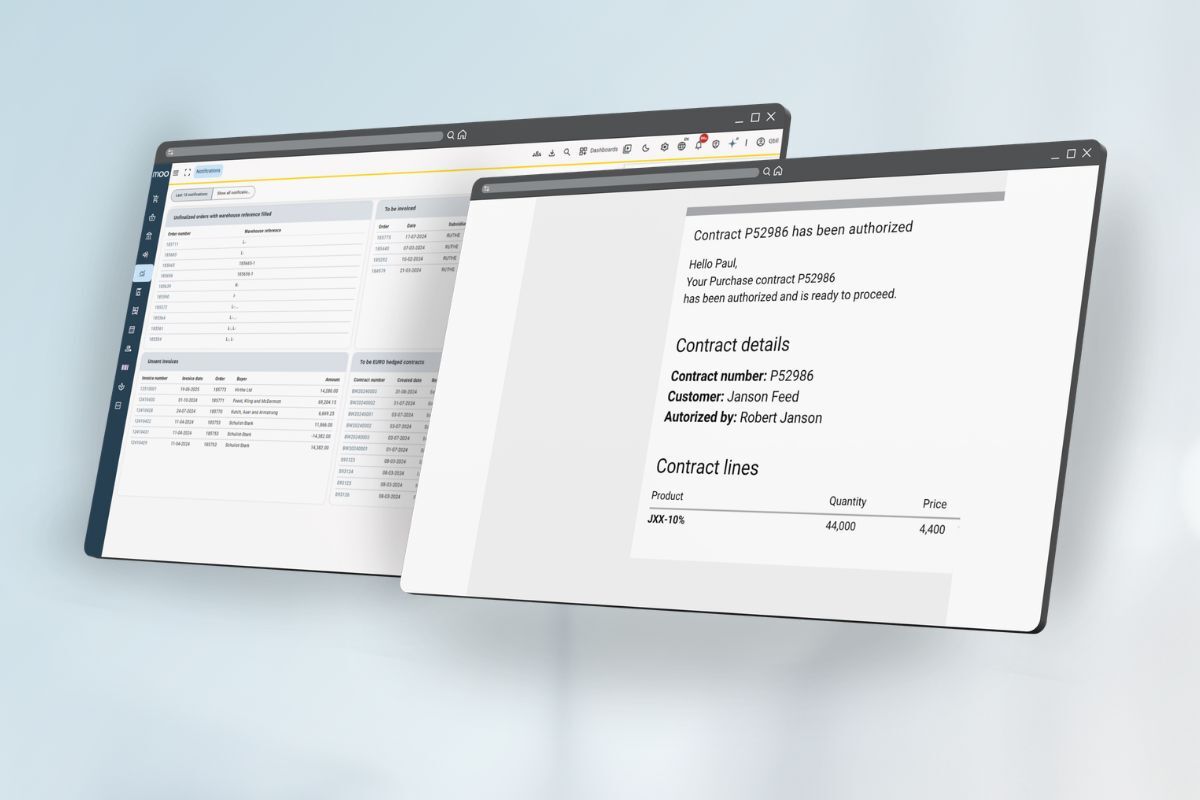
A connected ERP system protects against knowledge loss by storing operational data in a single shared environment rather than in personal files or inboxes. When contracts, orders, logistics, and financial records all live in one system, the knowledge is no longer tied to the person who entered it. Any team member with access can see the current state of the business, understand what is open, and pick up where someone else left off.
This is the practical difference between trading software and a collection of spreadsheets. A spreadsheet stores data. A trading ERP stores data in context — linked to contracts, counterparties, delivery schedules, and financial records, so that information makes sense without the person who created it having to explain it.
For dairy ingredient traders specifically, this matters across several areas. Contract positions are visible to the whole team in real time. Logistics arrangements are logged against the relevant order, not buried in someone’s email. Pricing and margin calculations follow consistent rules rather than individual interpretations. When someone new joins, they are not starting from scratch — they are stepping into a system that already holds the operational history of the business.
We built Moo Software specifically for this kind of trading environment. It is not a generic ERP adapted for dairy — it is a system designed around how dairy ingredient trading actually works, including the contract structures, position management, and logistics coordination that define the day-to-day. Your environment is fully operational within two days, so you are not looking at a long implementation before you start seeing the benefit.
The goal is not to replace the people who make your business work. It is to make sure the knowledge they carry is captured in a place that belongs to the business, not just to them. If you want to understand what that looks like in practice, get in touch and we can walk you through it.
FAQ broken data: JSON error 4