Most dairy ingredient traders use a combination of spreadsheets, email threads, and shared drives to manage their day-to-day operations. It works well enough in the early stages, but as trade volumes grow, these tools start showing their limits quickly. The sections below unpack exactly why that happens and what better alternatives look like.
Why do dairy ingredient traders outgrow spreadsheets so quickly?
Dairy ingredient traders outgrow spreadsheets quickly because the work is fundamentally real-time and multi-person, while spreadsheets are static by design. A contract signed today affects your open position, your logistics planning, and your invoicing simultaneously. A spreadsheet cannot reflect all of those changes at once for everyone who needs to see them.
The early warning signs are easy to miss. You start with one file for contracts, add another for stock levels, then a third for pricing, and before long you have a small ecosystem of files that only make sense to the person who built them. When a colleague updates one file without touching the others, the data drifts. Nobody notices until something goes wrong, and by then the damage is already done.
There is also the formula problem. A single copied formula error can quietly distort results for days or even weeks before anyone catches it. In dairy ingredient trading, where margins are tight and timing matters, that kind of silent failure is genuinely costly. Delayed data entry means delayed decisions, and in a market that moves quickly, that gap has real consequences.
The deeper issue is that spreadsheets were never designed to handle the operational connections that trading requires. A contract is not just a number in a cell. It is connected to a supplier, a delivery window, a logistics instruction, a payment term, and a position in your book. Managing all of those connections manually across separate files is not a workflow problem you can solve by building a better spreadsheet.
What tools do ingredient traders actually use to manage contracts?
In practice, most ingredient traders manage contracts through a mix of Excel files, email chains, and sometimes a shared folder or basic CRM. Smaller trading companies often rely on one person who holds most of the contract knowledge in their head, supported by a few spreadsheets that only they fully understand. This setup is more common than most people admit.
Beyond spreadsheets, some traders use general-purpose tools like shared Google Sheets, project management apps, or accounting software with custom workarounds. These can add a layer of visibility, but they still require manual effort to stay aligned. None of them were built with the logic of commodity trading in mind, so the workarounds tend to multiply over time.
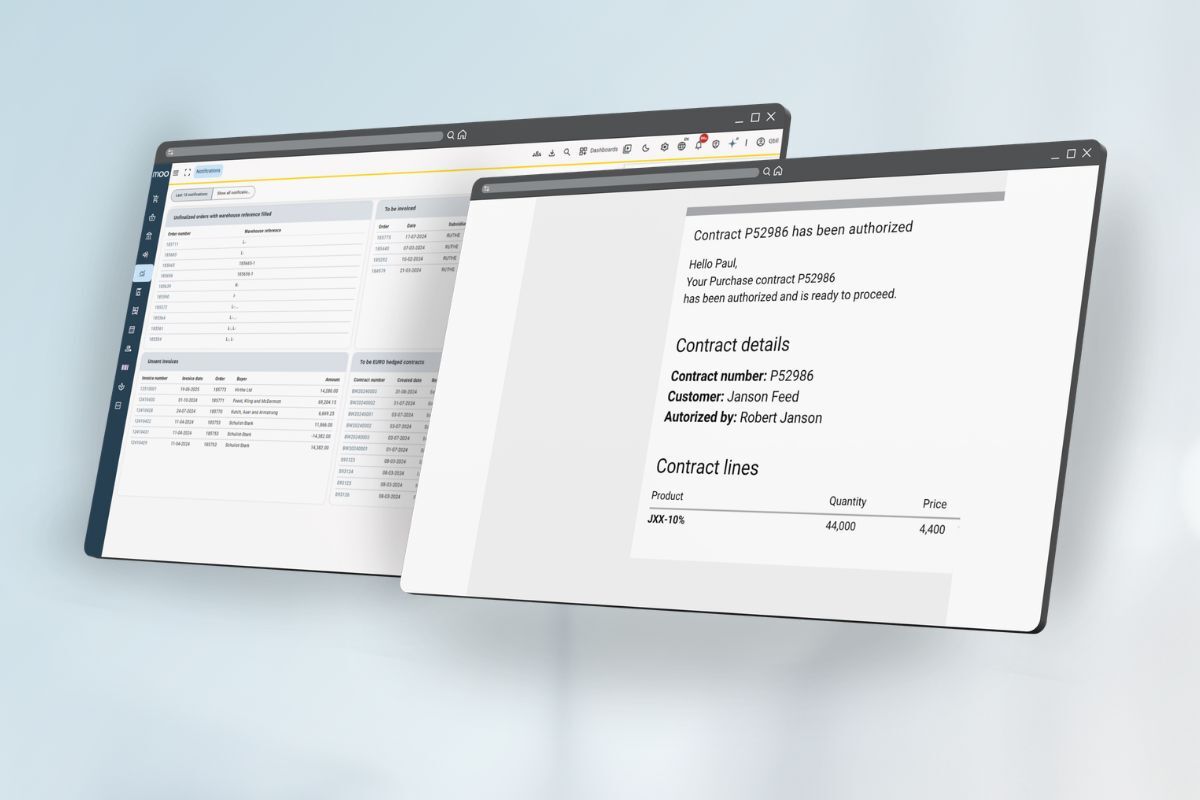
The more operationally mature trading companies move toward dedicated trading software or ERP systems built for their specific type of business. These systems connect contracts directly to orders, logistics, stock positions, and financials, so a change in one place automatically flows through to the others. That connection is what separates purpose-built trading software from the patchwork of general tools most traders start with.
De vergelijking tussen Excel versus handelssoftware is not really about features. It is about whether your tools reflect the way trading actually works. Excel reflects what you tell it. Trading software reflects what is actually happening.
What is an ERP system built for dairy ingredient trading?
An ERP system built for dairy ingredient trading is a single, connected platform that manages the full trading cycle, from contract to invoice, within one environment. Unlike generic ERP software, a dairy-specific system is designed around the workflows that ingredient traders actually use: commodity contracts, position management, logistics coordination, and multi-currency invoicing.
The key difference from a general ERP is context. A generic system requires significant customisation to handle commodity logic, and even then it often does not reflect how ingredient trading actually operates. A purpose-built system starts from that logic and builds outward.
What does a dairy trading ERP typically include?
A well-built dairy trading ERP covers the core operational areas that traders manage every day. These typically include contract management, order processing and logistics, stock and position tracking, and financial integration with your existing accounting system. The goal is that each of these areas talks to the others automatically, without manual re-entry.
Who is it designed for?
These systems are designed for companies trading in dairy commodities and ingredients, including milk powder, whey, butter, cheese, proteins, and plant-based alternatives. They suit businesses of different sizes, from smaller trading operations with a handful of staff to larger companies handling significant international volumes. Our ERP platform is built specifically for this type of trade, with multilingual support and cloud-based access suited to international operations.
How does position management work without a dedicated system?
Without a dedicated system, position management in dairy ingredient trading is almost always manual. Traders maintain a running picture of their open contracts, stock, and commitments across spreadsheets, and update them as new deals come in or deliveries go out. The position is only as accurate as the last person who updated the file, which means it is often slightly out of date.
The practical consequence is that traders make decisions based on a position that does not fully reflect reality. You might think you are covered on a certain product when you are actually short, or you might commit to a sale without realising your available stock has already been allocated elsewhere. These are not hypothetical errors. They happen regularly in trading operations that rely on manual tracking.
In a connected trading system, position management updates automatically as contracts are entered, orders are confirmed, and deliveries are processed. Your open position is always current, and everyone with access to the system sees the same picture. That real-time visibility is one of the clearest practical differences between managing a trading book in spreadsheets versus managing it in purpose-built software.
Position management is also where the Excel versus handelssoftware gap becomes most visible. A spreadsheet can show you a snapshot. A trading system shows you the live state of your book, which is what you actually need to trade confidently.
When should a dairy trading company switch from Excel to software?
A dairy trading company should consider switching from Excel to dedicated software when manual tracking starts creating operational risk. The clearest signal is when a mistake in your spreadsheets, a missed delivery, a contract error, or a data discrepancy causes a real problem rather than just a minor inconvenience. That moment usually arrives earlier than expected.
There are also quieter signals worth paying attention to before things go wrong. If your team spends significant time reconciling files, if you cannot answer a basic question about your current position without checking multiple sources, or if you are hesitant to bring on additional staff because onboarding them into your current system feels complicated, those are signs that your tools are limiting your growth.
The size of your company matters less than the complexity of your operations. A small team handling a high volume of contracts across multiple suppliers and markets will hit the limits of spreadsheet management faster than a larger team with simpler, more predictable flows. The question is not really about headcount. It is about whether your current tools give you the oversight you need to trade without unnecessary risk.
If you recognise your situation in any of these descriptions, the practical next step is simpler than it might seem. Get in touch with us to talk through what your current setup looks like and whether a purpose-built trading system would fit your operation. Our onboarding process is designed to get you fully operational quickly, without months of implementation work.
Veelgestelde vragen
How long does it typically take to migrate from spreadsheets to a purpose-built dairy trading system?
Migration timelines vary depending on the volume of historical data and the complexity of your current setup, but purpose-built dairy trading systems are generally designed for fast onboarding rather than lengthy implementation projects. Most companies can expect to be fully operational within a few weeks rather than months. The key preparation work involves consolidating your existing contract and counterparty data, which is also a good opportunity to clean up any inconsistencies that have built up over time.
Will my team need extensive technical training to use a dedicated trading ERP?
A purpose-built dairy trading ERP is designed around workflows that ingredient traders already know, so the learning curve is typically much shorter than with a generic ERP system. Most team members with a background in trading operations will find the core functions intuitive within the first few days of use. That said, investing time in structured onboarding at the start pays off significantly, especially for features like position management and logistics coordination that replace the most manual parts of your current process.
Can a dairy trading ERP integrate with the accounting software we already use?
Most purpose-built dairy trading systems are designed to integrate with common accounting platforms rather than replace them, since finance teams often have strong preferences for their existing tools. Integration typically covers invoice generation, payment tracking, and multi-currency reconciliation, so financial data flows automatically without manual re-entry. It is worth confirming specific integration compatibility with your software provider before committing, as the depth of integration can vary between systems.
What happens to our data if we switch systems mid-year during an active trading period?
Switching systems during an active trading period is manageable with the right approach, and many companies do it without waiting for a clean start-of-year window. The standard practice is to run a parallel period where both systems are used simultaneously for a short time, allowing you to verify that open contracts, positions, and pending deliveries are accurately reflected in the new system before fully cutting over. Your software provider should be able to guide you through this process with a clear data migration plan.
How does a trading ERP handle multi-currency contracts and international logistics?
A dairy trading ERP built for international operations handles multi-currency contracts natively, meaning you can enter, track, and invoice in different currencies without manual conversion steps or separate workarounds. Logistics coordination is typically integrated as well, so shipping instructions, delivery windows, and freight documentation are connected directly to the underlying contracts. This is one of the areas where purpose-built systems provide the most immediate value over general tools, since international trading involves too many moving parts to manage reliably through spreadsheets and email alone.
What are the most common mistakes companies make when evaluating trading software?
The most common mistake is evaluating trading software primarily on the number of features rather than on how well those features reflect the actual logic of commodity trading. A system that looks comprehensive in a demo but requires heavy customisation to handle dairy-specific workflows will create the same patchwork problems you were trying to escape. A second common mistake is underestimating the cost of staying on spreadsheets, since the risks of manual tracking, including position errors, missed deliveries, and slow decision-making, are often invisible until they cause a serious problem.
Is a dedicated trading system worth it for a smaller dairy trading operation?
Size matters less than operational complexity when assessing whether dedicated software is worthwhile. A small team managing a high volume of contracts across multiple suppliers, markets, and currencies will hit the limits of manual tools much faster than a larger team with simpler, more predictable flows. The more relevant question is whether your current tools give you the real-time visibility and control you need to trade confidently and scale without adding unnecessary risk, and for most growing dairy ingredient traders, the honest answer is that they do not.