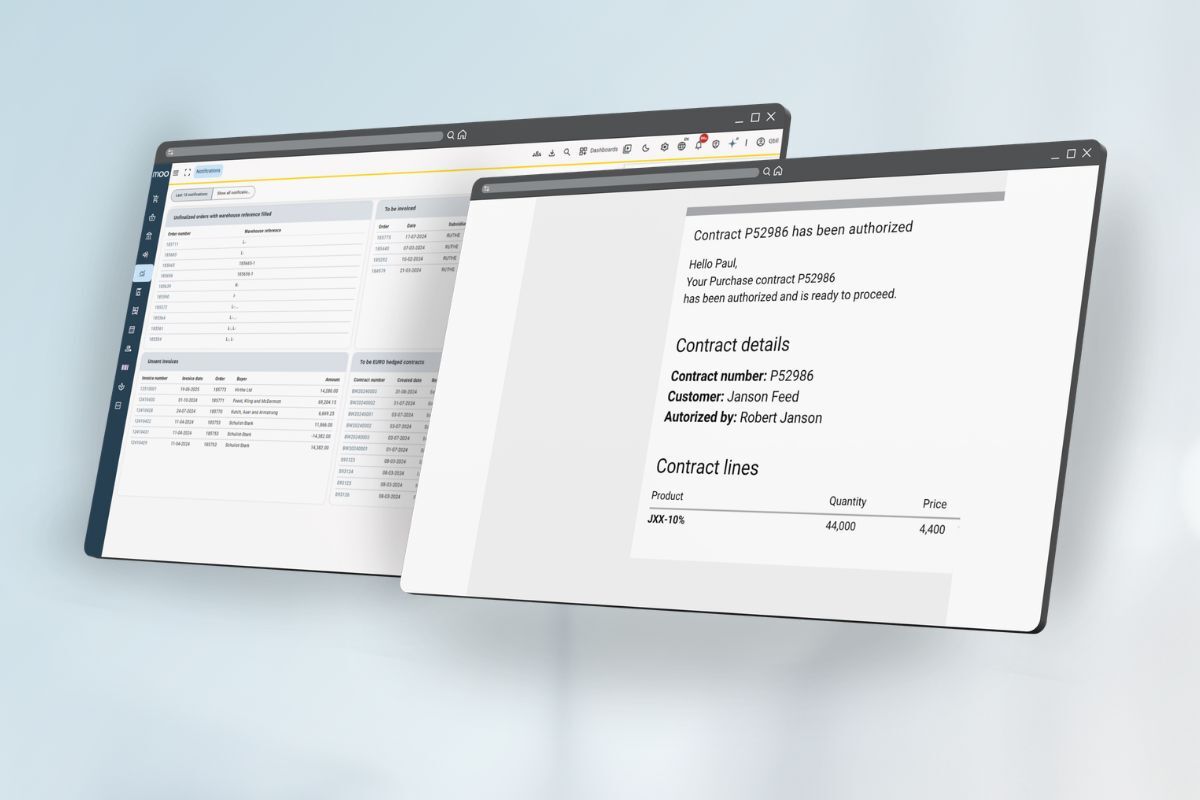

Getting a clear overview of open contracts is hard because the information rarely lives in one place. Prices get confirmed by email, quantities are noted in a spreadsheet, delivery dates are tracked in a separate file, and updates happen in WhatsApp or over the phone. By the time you try to piece it all together, something is already out of date.
For dairy ingredient traders specifically, this fragmentation is not just inconvenient. It creates real risk. Contracts move fast, involve multiple parties across different countries, and depend on logistics timing that changes constantly. A static spreadsheet was never designed to keep up with that reality.
The questions below unpack exactly why contract oversight is so difficult in dairy trading, what a proper overview should actually contain, and what you can do about it.
Why do contract details end up scattered across so many places?
Contract details end up scattered because each step in a trade tends to happen through a different channel. A price is agreed by phone, confirmed by email, entered into a spreadsheet, and then updated again when logistics change. There is no single moment when all of that information flows into one structured place. Each person involved adds their piece somewhere different.
This is not a problem that starts with bad habits. It starts with the way small trading teams work. When there are only two or three people handling everything, informal systems feel efficient. You know where things are because you put them there yourself. But as soon as a second person joins, or the number of active contracts grows past a certain point, the informal system starts to break down.
The result is a patchwork. Email threads contain the most recent price. A shared drive holds the original contract document. A spreadsheet tracks what has been invoiced. A calendar shows delivery dates. None of these are wrong on their own, but together they create a situation where no single view is ever fully complete or fully trusted.
What makes dairy contracts harder to track than other trade contracts?
Dairy contracts are harder to track than most trade contracts because they combine price volatility, short delivery windows, quality specifications, and regulatory requirements all at once. A single contract for milk powder might involve a price tied to a market reference, a delivery date that depends on cold chain availability, and documentation requirements that vary by destination country. That is a lot of moving parts for one line item.
Unlike contracts for stable commodities, dairy products can shift in value between the time a contract is signed and the time it is delivered. This means traders often need to monitor not just whether a contract is on track, but whether the terms still make commercial sense. That requires more than a static record. It requires a live view.
Add to this the fact that many dairy ingredient traders work across multiple product categories at the same time. Butter, whey powder, casein, and plant-based alternatives each come with their own market dynamics, supplier relationships, and logistics requirements. Tracking all of these in separate files makes it nearly impossible to see the full picture at any given moment.
How do most small dairy traders currently manage open contracts?
Most small dairy traders manage open contracts through a combination of Excel spreadsheets, email folders, and personal memory. One spreadsheet tracks active contracts, another tracks invoices, and a third might handle inventory or planning. Email threads serve as the unofficial record of what was agreed and what changed. This is the standard setup for a large number of ingredient trading businesses in 2026.
The system works well enough in the early stages. When one person manages ten contracts, they can hold most of the relevant context in their head. The spreadsheet just confirms what they already know. But this approach has a fundamental weakness: it depends entirely on individual knowledge and manual updates.
When a formula gets copied incorrectly, the error can quietly distort results for weeks before anyone notices. When a colleague is out sick, their part of the picture disappears. When a contract gets updated after the spreadsheet was last saved, the file no longer reflects reality. These are not edge cases. They are the normal operating conditions for a growing trading business using static tools.
The comparison between Excel vs trading software is not really about features. It is about whether your system can keep up with the pace and complexity of actual dairy trade. Spreadsheets are built for analysis. They are not built for real-time operations involving multiple people, live data, and time-sensitive decisions.
What information does a clear contract overview actually need to show?
A clear contract overview needs to show, at a minimum, the current status of every open contract in one view. That means the product, quantity, agreed price, counterparty, delivery date, and whether each milestone has been completed or is still pending. Without all of these elements visible together, you do not have an overview. You have a list.
Beyond the basics, a genuinely useful contract overview should also show:
- What has already been invoiced versus what is still outstanding
- Logistics status including shipment confirmations and expected delivery windows
- Any open actions such as missing documents, pending approvals, or unconfirmed quantities
- Position exposure showing how your open contracts relate to your current inventory and forward commitments
- Counterparty details so you can see at a glance which supplier or buyer each contract belongs to
The reason most traders do not have this view is not that the information does not exist. It is that the information lives in too many places to assemble it quickly. A real contract overview is not something you build by copying data from three files into a fourth. It should be the natural output of how your business records and updates information every day.
When does a lack of contract overview start causing real business problems?
A lack of contract overview starts causing real business problems the moment a decision gets made on incomplete information. That might be a delivery that gets booked before a contract is fully confirmed, an invoice sent for the wrong quantity, or a margin calculation that misses a price adjustment agreed two weeks earlier. These are not theoretical risks. They are the kinds of errors that happen regularly in trading businesses that rely on fragmented systems.
The problems tend to escalate in predictable patterns. Early on, mistakes are small and recoverable. A missed detail gets caught before it becomes a financial issue. But as the business grows and the number of active contracts increases, the same informal system that worked before starts producing errors faster than they can be corrected.
Some of the most common breaking points include:
- A key employee leaving and taking their mental model of the contract status with them
- A customer dispute over quantities or delivery terms that cannot be resolved quickly because the records are unclear
- A missed delivery window because the logistics booking was based on an outdated contract date
- A financial close that takes days instead of hours because invoices and contracts have to be reconciled manually
These moments are often what prompts traders to look for a better solution. The problem existed long before the breaking point, but the breaking point is what makes it visible.
How can dairy trading companies get a real-time view of all open contracts?
Dairy trading companies can get a real-time view of all open contracts by moving from static, file-based tracking to a system where contract data is entered once and automatically reflected across every relevant part of the business. That means orders, logistics, inventory, and invoicing all connect back to the same contract record. When something changes, the change is visible everywhere immediately.
The practical path to this looks different depending on where a business currently is. For most small traders, the starting point is recognizing that the problem is not about working harder or being more disciplined with spreadsheets. The structure itself is the limitation. Spreadsheets require manual updates, do not support multiple users editing simultaneously in a reliable way, and cannot automatically link a contract change to an invoice or a logistics booking.
Purpose-built Molkereihandel-Software solves this by treating the contract as the central record that everything else flows from. When a contract is created, it drives the order. When the order is fulfilled, it drives the invoice. When the invoice is sent, it updates the position. There is no manual step where information needs to be copied from one file to another, which is exactly where errors enter the system.
For companies that have been running on spreadsheets for years, the idea of switching to a new system can feel like a large project. But the reality is that modern trading software for dairy ingredients is designed to get you operational quickly. We built Moo Software specifically for ingredient traders who want the control of a proper ERP without the complexity or cost of a large implementation. Your environment can be fully operational within two days, and you only pay for what you actually use.
If you have been managing contracts across multiple files and are starting to feel the limits of that approach, it is worth talking to us about what a connected system would look like for your business.
Häufig gestellte Fragen
How long does it typically take to migrate from spreadsheets to dairy trading software?
For most small to mid-sized dairy ingredient traders, the migration is faster than expected. Modern purpose-built trading platforms are designed to get you operational within days, not months. The key is to start by importing your active contracts and open positions first, so your team has a live view immediately, and then layer in historical data over time. Trying to migrate everything at once before going live is one of the most common mistakes that slows teams down.
What if my team is resistant to moving away from Excel?
Resistance to change is normal, especially when a team has built their workflows around a familiar tool. The most effective approach is to demonstrate the problem rather than argue about the solution — show your team a specific moment where the spreadsheet failed: a missed update, a reconciliation that took hours, or a contract detail that was out of sync. Once the limitation is concrete and personal, the case for a better system becomes much easier to make. Involving key users early in the evaluation process also significantly increases adoption.
Can a connected contract system still work if some counterparties communicate only by email or phone?
Yes — the system does not need to change how your counterparties communicate with you. The difference is in how your team captures and records that information internally. When a price update comes in by phone or email, it gets entered into the central contract record once, and from that point it is reflected everywhere automatically. The goal is not to force external parties onto a platform, but to eliminate the internal step where information gets lost or duplicated between channels.
What are the biggest mistakes traders make when trying to improve contract oversight?
The most common mistake is adding more spreadsheets to fix the problems caused by existing spreadsheets — for example, creating a new summary tab that pulls from three other files. This adds complexity without solving the underlying issue, which is that static files require constant manual maintenance. Another frequent mistake is waiting for a complete data cleanup before implementing a new system. In practice, starting with your current active contracts and cleaning data progressively is far more effective than delaying until everything is perfect.
How should a contract overview handle contracts that span multiple shipments or partial deliveries?
A proper contract overview should allow you to track the full contracted quantity at the top level while also showing each individual shipment or delivery milestone underneath it. This means you can see at a glance how much of a contract has been fulfilled, what is still in transit, and what remains to be shipped — all tied back to the original agreed terms. Spreadsheets struggle with this because partial deliveries often require manual row duplication or formula adjustments that introduce errors over time.
Is contract overview software only useful for larger trading businesses, or does it make sense for smaller operations too?
It makes sense at almost any scale, but the tipping point tends to come earlier than most small traders expect. Once you are managing more than 15 to 20 active contracts simultaneously, or as soon as a second person needs reliable access to the same contract data, the informal system starts to create more friction than it saves. The cost and complexity of purpose-built trading software has dropped significantly, and platforms like Moo Software are specifically designed for small ingredient trading teams rather than large enterprise operations.
How does better contract visibility actually impact commercial decisions, not just administrative ones?
When you can see all open contracts, positions, and outstanding deliveries in one place, you make faster and more confident commercial decisions. For example, knowing your exact forward exposure on butter before quoting a new contract prevents over-committing. Seeing which contracts have uninvoiced balances helps you manage cash flow proactively rather than reactively. The administrative benefit is real, but the bigger value is that reliable data changes how quickly and accurately your team can respond to market opportunities or supply disruptions.