
Version control is a problem in small trading companies because most of them never set up a version control system in the first place. Instead, they rely on shared spreadsheets, email attachments, and locally saved files — each of which creates a separate, competing version of the truth. The result is that nobody is ever fully certain which number is correct, which contract reflects the latest negotiation, or which order status is current. The sections below unpack why this happens, how to spot it, and what small trading companies can actually do about it.
What actually causes version control problems in trading companies?
Version control problems in trading companies are caused by the gap between how spreadsheets work and how trading actually works. Spreadsheets are static files — they capture a moment in time. Trading is continuous, multi-person, and constantly changing. When more than one person needs access to the same data, files get copied, emailed, and edited separately, and the original loses its authority almost immediately.
The root cause is not carelessness. It is a structural mismatch. A trader updates a contract price in their local copy of a file. A colleague is working from the version they downloaded that morning. A third person emails a PDF of the version from last week. All three believe they are working from the current document. None of them are wrong to think that — they simply have no reliable way to know otherwise.
In dairy ingredient trading specifically, this problem compounds quickly. Contracts reference commodity prices that shift, delivery windows that narrow, and counterparty details that get renegotiated. Every update to any of those variables should immediately be visible to everyone involved. In a spreadsheet environment, that kind of real-time synchronization is not possible by design.
What are the signs that version control is breaking down?
The clearest signs that version control is breaking down are files with names like “final,” “final_v2,” and “final_ACTUAL” sitting in the same folder, alongside recurring moments where two colleagues quote different numbers for the same contract. These are not isolated incidents — they are symptoms of a system that has outgrown its structure.
Other signs include:
- Colleagues regularly asking each other “which version are you using?” before a meeting
- Corrections being made in one file but not reflected elsewhere
- Discrepancies between what was invoiced and what was agreed, discovered only after the fact
- New team members creating their own copies because they cannot trust the shared files
- Decisions being delayed because nobody is confident the data they have is current
The most dangerous sign is one that often goes unnoticed: a formula error that quietly propagates through a spreadsheet for days or weeks before anyone catches it. Unlike a visible mistake, a silent calculation error distorts every decision made during that window. By the time it surfaces, the damage is already done.
How does a single version control error affect a trading operation?
A single version control error in a trading operation can trigger a chain of downstream consequences that are disproportionate to the original mistake. A contract detail updated in one file but not in another means that logistics, invoicing, and customer communications can all proceed based on outdated information — each step compounding the original error before anyone realizes what happened.
Consider a practical example. A dairy ingredient trader renegotiates a delivery date with a supplier. The update gets made in the trader’s working file but not in the shared planning sheet the logistics team uses. The original delivery is processed, the customer receives the wrong quantity at the wrong time, and the complaint arrives before anyone connects it to the file discrepancy. The version control failure was a single missed update. The operational fallout involved multiple teams, a customer relationship, and time spent on damage control instead of trading.
This is why the Excel vs trading software conversation matters in practice rather than in theory. It is not about whether spreadsheets are capable tools in isolation. It is about whether they can maintain a single, trusted version of operational reality when multiple people are working simultaneously across contracts, orders, and logistics. The honest answer is that they cannot.
Why do small trading companies struggle with version control more than larger ones?
Small trading companies struggle with version control more than larger ones because they typically lack the dedicated systems, IT infrastructure, and formal processes that larger organizations put in place precisely to solve this problem. A company with five people sharing files over email operates on trust and habit rather than structure — and that works until it suddenly does not.
Larger trading companies invest in centralized systems early, often because they have experienced version control failures at scale and understand the cost. Small companies tend to build their operations around what is available and free — spreadsheets, shared drives, email threads — and add complexity gradually as the business grows. The problem is that the tools do not grow with the business. The spreadsheet that worked for two people becomes unmanageable for eight.
There is also a mindset factor. In smaller operations, the assumption is often that “this is just how our industry works.” Spreadsheets and email feel normal because everyone around them uses the same approach. The comparison point for the Excel vs trading software question never comes up naturally because nobody has experienced the alternative. The problem does not have a name, so it does not get solved — it just gets tolerated until something goes wrong.
How do trading companies fix version control without overhauling everything?
Trading companies fix version control by replacing the shared file system with a single source of truth — one environment where contracts, orders, positions, and logistics all live together and update in real time. This does not require a disruptive, months-long implementation. The practical fix is moving operational data out of spreadsheets and into a connected system where every update is immediately visible to everyone who needs it.
The key is starting with the data that causes the most version control pain. For most small dairy trading companies, that tends to be contract positions and order status — the two areas where an outdated version causes the most operational damage. Moving those into a centralized system eliminates the file-copying problem at its source.
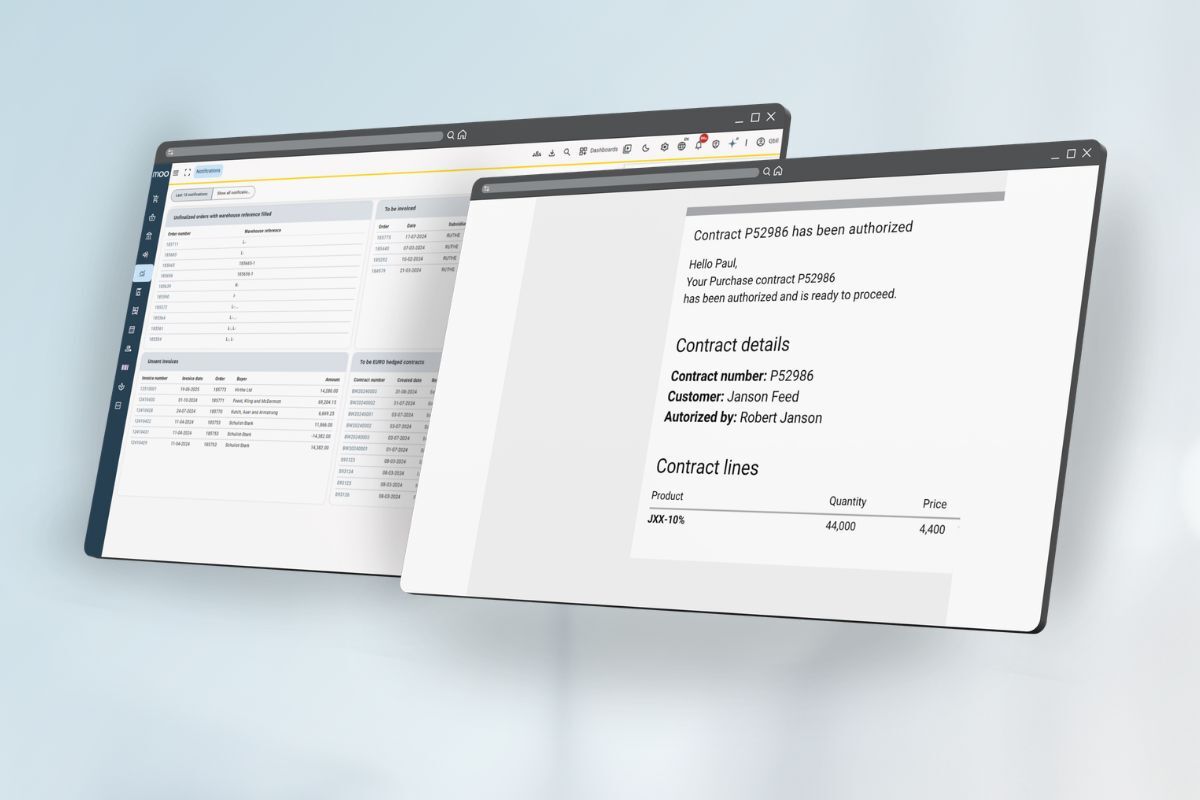
Wir haben gebaut Moo Software specifically for this reality. It is designed for dairy ingredient and commodity traders who want to stop managing multiple file versions and start working from a single, connected view of their contracts, inventory, logistics, and financials. The onboarding process is structured so that your environment is fully operational within two days — not weeks or months. There is no need to overhaul everything at once. The goal is simply to give your team one place where the current version is always the only version.
For companies that have grown used to spreadsheets, the shift feels significant at first. In practice, it removes a category of daily friction that most teams have stopped noticing precisely because they have been living with it for so long. Version control stops being a problem when there is only ever one version to work from.
Häufig gestellte Fragen
How long does it typically take to migrate from spreadsheets to a centralized trading system?
For most small trading companies, the migration is faster than expected — purpose-built platforms like Moo Software are designed to get your environment fully operational within two days. The key is to prioritize migrating the data that causes the most version control pain first, such as active contracts and open orders, rather than attempting a complete historical data transfer upfront. A phased approach means your team can start working from a single source of truth almost immediately without disrupting live operations.
What if my team is resistant to moving away from spreadsheets?
Resistance is normal and usually stems from familiarity rather than a genuine preference for the tool. The most effective way to address it is to make the cost of the current system visible — track how many times per week your team asks 'which version are you using?' or how many hours are spent reconciling discrepancies. Once the hidden friction is quantified, the case for change becomes concrete rather than theoretical. A short trial period on a centralized system, starting with just one workflow, is often enough to shift the conversation.
Can version control problems occur even when using cloud-based spreadsheets like Google Sheets or shared Excel files?
Yes — cloud-based spreadsheets reduce some version control risks by allowing simultaneous editing, but they do not eliminate the core problem. Multiple people can still overwrite each other's changes, formula errors still propagate silently, and there is still no structured audit trail showing who changed what and when. More critically, cloud spreadsheets remain disconnected from your other operational data — contracts, logistics, and invoicing still live in separate files, meaning the version fragmentation problem simply moves to a different level.
How do I know if a version control issue has already caused financial damage in my business?
The clearest indicators are invoice-to-contract discrepancies discovered after the fact, customer complaints about delivery quantities or timing that trace back to outdated planning data, and margin calculations that do not match final settlement figures. A useful internal audit is to pick five recently closed contracts and manually verify that the price, quantity, delivery date, and counterparty details are identical across every file and communication thread that referenced them. Inconsistencies in even one of those contracts are a reliable sign that financial exposure has already occurred.
What is the minimum a small trading company should do right now if a full system migration is not immediately possible?
If a full migration is not yet on the table, the single most impactful immediate step is to designate one file — not a folder, one file — as the official master record for active contracts, and enforce a strict rule that all updates happen there first. Pair this with a simple change log tab that records what was updated, by whom, and when. This does not solve the structural problem, but it reduces the number of competing versions and makes discrepancies easier to trace while you work toward a longer-term solution.
Are there specific types of dairy ingredient trades that are more vulnerable to version control failures than others?
Yes — trades with multiple pricing variables, such as those tied to commodity indices or subject to renegotiation, are significantly more vulnerable because any price change requires updates across contracts, position sheets, and financial summaries simultaneously. Similarly, trades involving multiple delivery tranches or split shipments create more version control touchpoints, since each tranche may be updated independently by different team members. The more moving parts a trade has, the higher the probability that at least one file will be out of sync at any given moment.
What should I look for when evaluating trading software to ensure it actually solves the version control problem?
Look for three things: a single unified data environment where contracts, orders, logistics, and financials are connected rather than stored separately; a real-time update model so that any change is immediately visible to all users without manual syncing; and a clear audit trail that records every change with a timestamp and user attribution. Be cautious of solutions that simply replicate your spreadsheet structure in a digital format — the goal is not a prettier spreadsheet, but a fundamentally different architecture where only one version of the truth can exist.