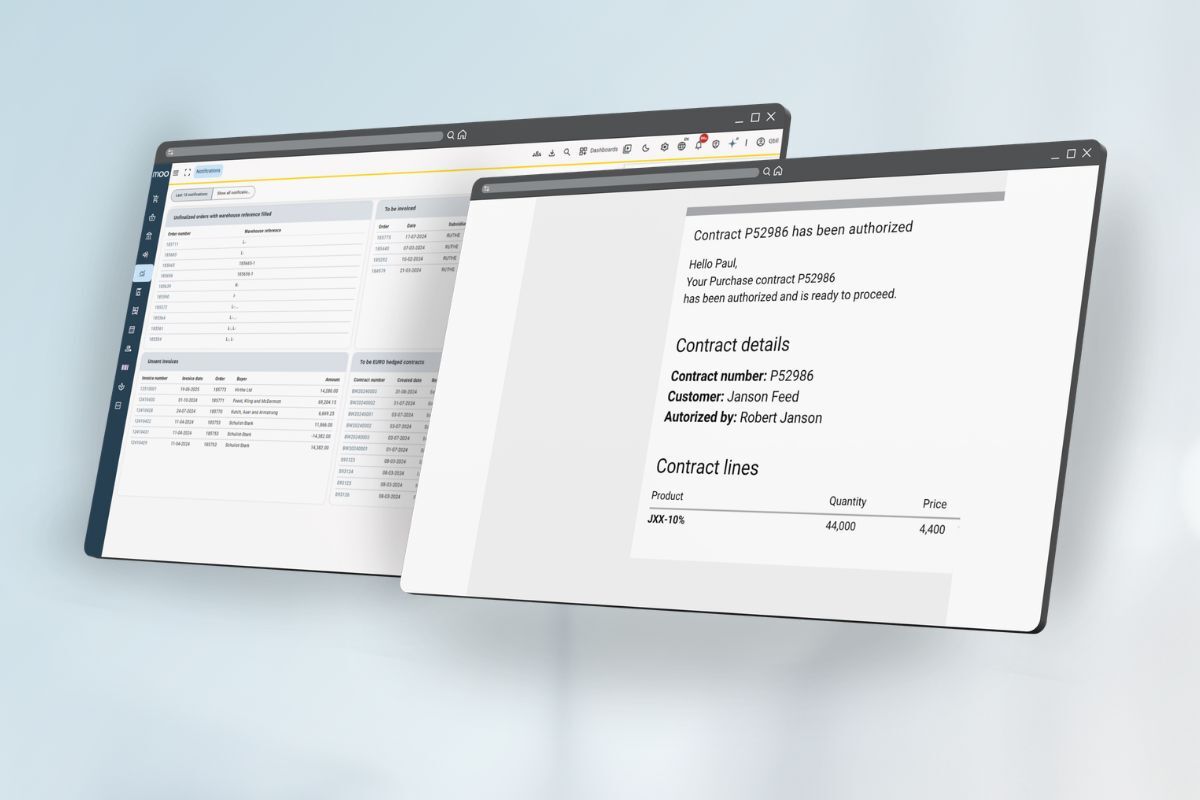

Operational mistakes in dairy ingredient trading most commonly happen when critical information lives in disconnected places. A contract detail sits in an email, a stock figure lives in a spreadsheet, and a delivery update exists only in someone’s memory. When those pieces don’t connect in real time, errors don’t just happen — they compound quietly until they become expensive problems.
For smaller trading teams, this isn’t a sign of carelessness. It’s a structural issue: the tools being used were never designed for the pace and complexity of commodity trading. The questions below unpack exactly where things go wrong and what it takes to get ahead of them.
What are the most common sources of operational errors in dairy ingredient trading?
The most common sources of operational errors in dairy ingredient trading are fragmented data, manual data entry, and poor version control across documents. When contracts, orders, stock positions, and logistics are tracked in separate files or systems, inconsistencies build up silently — and by the time someone notices, the error has already had consequences.
In practice, these errors tend to cluster around a few recurring patterns:
- Contract mismatches: A price, volume, or delivery window gets updated in one place but not in the documents or records that reference it downstream.
- Stock discrepancies: Inventory figures are recorded after the fact rather than in real time, meaning decisions get made on data that is already out of date.
- Logistics miscommunication: Delivery instructions are shared by email or phone, with no single source of truth that all parties can reference.
- Invoice errors: Manual re-entry of order data into accounting systems introduces small mistakes that only surface when a customer queries a figure.
What makes these errors particularly damaging in dairy ingredient trading is the perishable nature of the products and the tight margins involved. A delayed delivery or a mispriced contract doesn’t just cause administrative inconvenience — it affects customer relationships, cash flow, and your position in the market.
Why do small dairy trading teams rely on spreadsheets for so long?
Small dairy trading teams rely on spreadsheets for so long because spreadsheets work well in the early stages of a business. When you’re handling a handful of contracts and a small product range, a well-organised Excel file genuinely covers what you need. The problem isn’t that spreadsheets are bad tools — it’s that they don’t scale with the complexity of a growing trading operation.
There’s also a mindset factor at play. Many traders in the dairy and ingredients space have built their businesses on industry knowledge, relationships, and instinct. The idea that a software system could add meaningful value often feels abstract until something goes wrong. Excel is familiar, flexible, and free. That combination is hard to argue against until the hidden costs become visible.
The shift from “this works” to “this is a problem” usually happens gradually. One spreadsheet becomes five. One person managing the files becomes three, each with their own version. Formulas get copied, adjusted, and occasionally broken. And because the errors are quiet rather than dramatic, the system keeps running — just with less reliability than anyone realises.
When comparing Excel vs trading software, it’s not really a question of which is better in isolation. It’s a question of what stage your operation is at. Spreadsheets are static by design. A dairy trading business is not.
How does a single data entry mistake ripple through a dairy trading operation?
A single data entry mistake in dairy ingredient trading can ripple through an entire operation because the same piece of data is typically referenced across multiple processes: contract valuation, stock planning, logistics scheduling, and invoicing. When the source data is wrong, every downstream action built on it is wrong too — often without anyone realising until the damage is done.
Consider a practical example. A trader updates a contracted volume in their order sheet but forgets to reflect the change in the stock planning file. The logistics team schedules a pickup based on the old figure. The warehouse prepares the wrong quantity. The customer receives a short delivery. By the time the complaint arrives, the original entry error is three steps removed from the visible problem — making it harder to trace and slower to fix.
What makes this pattern so persistent is that each individual step looks correct in isolation. The logistics team did their job based on the information they had. The warehouse team did theirs. The error was upstream, invisible to everyone acting on it. This is the structural weakness of managing operations across disconnected files: there is no single source of truth that keeps all parts of the process aligned.
In a business with tight delivery windows and perishable products, these cascading errors are not just frustrating — they are costly. And the more staff involved in a process, the more opportunities there are for a single mistake to branch into multiple problems simultaneously.
What role does real-time visibility play in preventing trading mistakes?
Real-time visibility prevents trading mistakes by ensuring that everyone working in a dairy trading operation is acting on the same, current information at the same time. When contract positions, stock levels, and order statuses update instantly across the whole system, there is no gap between what happened and what the team knows — which is exactly where most errors originate.
The difference between real-time data and end-of-day data entry is more significant than it might seem. In dairy ingredient trading, conditions change quickly. A contract gets amended in the morning, a delivery gets rescheduled by midday, and a new order comes in by afternoon. If your team is working from a spreadsheet that was last updated the evening before, every decision made during that day is based on a snapshot of reality that no longer exists.
Real-time visibility also changes how teams communicate. Instead of relying on emails, phone calls, and manual updates to keep everyone aligned, a connected system means that the information itself does the communicating. A change made by one person is immediately visible to everyone else who needs to act on it. That removes a whole category of errors that come not from bad intentions but from simple information lag.
For growing dairy trading businesses, this kind of operational clarity is often the difference between reacting to problems and preventing them. Our trading software is built around this principle — giving every part of the operation a shared, live view of positions, orders, and logistics.
When should a dairy ingredient trader start looking for operational software?
A dairy ingredient trader should start looking for operational software when the cost of managing without it becomes higher than the cost of changing. That tipping point is different for every business, but there are reliable signals that indicate the current setup is no longer serving the operation well.
The most common signs that it’s time to look beyond spreadsheets and email include:
- You’ve had a mistake that cost you money or a customer relationship — and when you traced it back, the root cause was a data gap or a miscommunication between files.
- You can’t answer basic questions quickly — such as your current open position, what’s in transit, or what invoices are outstanding — without pulling data from multiple places.
- New team members struggle to get up to speed because the system only makes sense to the person who built it.
- You’re spending more time managing your files than managing your trade — reconciling versions, chasing updates, and correcting entries rather than focusing on deals and relationships.
- Growth is creating chaos rather than momentum — more contracts, more products, and more staff are making the operation harder to run rather than easier.
The good news is that switching to purpose-built trading software doesn’t have to be a long or disruptive process. Unlike generic ERP systems that require months of configuration, a solution designed specifically for dairy ingredient trading can be operational far more quickly. If you’re recognising your business in the signals above, getting in touch to explore your options is a practical next step — not a major commitment.
The question most traders ask too late is not “should we get software?” but “why didn’t we do this sooner?” When Excel vs trading software is no longer a comparison but a clear choice, the transition tends to happen faster and more smoothly than expected.
Preguntas frecuentes
How do I get started with transitioning from spreadsheets to trading software without disrupting daily operations?
The key is to look for software built specifically for dairy ingredient trading rather than a generic ERP system, as purpose-built solutions require far less configuration and can go live much faster. Start by mapping your current workflows — contracts, stock tracking, logistics, and invoicing — so you can evaluate how a new system will handle each one. A good software provider will guide you through onboarding in stages, meaning you don't have to switch everything over at once. Running the new system in parallel with your existing setup for a short period can also ease the transition and build team confidence.
What if my team is resistant to adopting new software after years of working with spreadsheets?
Resistance usually comes from familiarity and a fear of disruption rather than opposition to improvement — and the best way to address it is to make the benefit tangible early. Involve key team members in the evaluation process so they feel ownership over the decision, and prioritise software with a clean, intuitive interface that doesn't require extensive training. Pointing to a specific recent mistake — a short delivery, an invoice query, a version control issue — and showing how the software would have prevented it tends to be more persuasive than any abstract argument. Once the team experiences real-time visibility and fewer fire-fighting moments, adoption typically accelerates on its own.
Are there specific dairy ingredient categories where operational errors tend to be more costly or frequent?
Errors tend to be most costly in high-volume, short-shelf-life categories such as fresh cream, liquid milk, and certain whey products, where a logistics miscommunication or stock discrepancy can result in product loss rather than just a paperwork correction. Commodity products traded in large volumes — like skim milk powder or butterfat — are particularly vulnerable to contract mismatch errors, where even a small price or volume discrepancy across a large tonnage has a significant financial impact. Specialty ingredients with complex specification requirements add another layer of risk, as errors in product details can lead to rejected loads or compliance issues. Knowing which categories carry the most operational risk in your own portfolio is a useful starting point for prioritising where better data management will have the greatest impact.
How can I tell whether a data error or a process problem is causing our operational mistakes?
A useful diagnostic is to trace your most recent operational mistake back to its origin: if it started with incorrect or outdated information — a wrong figure, a stale spreadsheet, a missed update — it's primarily a data problem, and better systems will address it directly. If the information was correct but the wrong action was taken, the issue is more likely a process or communication gap, though these are often symptoms of the same underlying fragmentation. In practice, most operational errors in dairy trading involve both: a process that relies too heavily on manual data transfer creates the conditions for data errors to occur. Mapping out how information flows from contract creation through to invoicing will usually reveal where the weakest links are.
What should I look for in trading software to make sure it actually reduces errors rather than just digitising the same problems?
The most important thing to look for is a single, connected data environment — meaning contracts, stock positions, orders, and logistics all live in the same system and update in real time, rather than being separate modules that require manual syncing. Look for features like automated document generation from contract data, which eliminates re-entry errors, and audit trails that show who changed what and when, making it easier to trace mistakes when they do occur. Role-based access and approval workflows are also valuable, as they add a layer of control that prevents unreviewed changes from flowing downstream. If a software demo shows you the same data in multiple disconnected screens that require manual updates between them, that's a sign the tool may replicate your current problems rather than solve them.
Is operational software worth the investment for a very small dairy trading team — say, two or three people?
For a team of two or three, the case for purpose-built software is often stronger than it appears, because small teams carry a disproportionate operational risk: there is less redundancy, so a single person's absence or a single file error has an outsized impact on the whole operation. The efficiency gains — less time spent reconciling spreadsheets, chasing updates, and correcting invoice errors — are also felt more acutely at small scale, where every hour matters. The question isn't really about team size but about trade volume and complexity: if you're managing multiple contracts, suppliers, and logistics movements simultaneously, the structural limitations of spreadsheets apply regardless of headcount. Many purpose-built trading platforms are priced with smaller operations in mind, making the cost-benefit calculation more favourable than traders often assume.
How do I build a business case internally for switching to trading software if leadership is focused on keeping costs down?
The most effective approach is to quantify the cost of your current errors rather than arguing for the cost of new software — calculate the value of a recent short delivery, a disputed invoice, or the staff hours spent weekly on manual reconciliation and version control. Even conservative estimates of error-related costs tend to outweigh software subscription fees when presented clearly. It also helps to frame the conversation around risk: as trade volumes grow, the probability of a costly mistake increases, and the consequences become harder to absorb. Presenting a specific, time-bound pilot — rather than a permanent commitment — often lowers the perceived risk of the decision and makes it easier to get initial approval.