
Sticking to spreadsheets costs a dairy trader more than most people realise until something actually goes wrong. The losses are not just financial — they show up as wasted hours, missed contract details, outdated position data, and decisions made using information that is already out of date. For smaller trading companies handling multiple contracts, counterparties, and logistics streams at once, those losses compound quietly over time.
The questions below unpack exactly where spreadsheet-based trading breaks down, and why the gap between Excel and purpose-built trading software widens as your business grows.
What goes wrong when a contract slips through the cracks?
When a contract slips through the cracks in a spreadsheet-based setup, the consequences are immediate and often expensive. A missed delivery window, an unconfirmed price fixation, or a quantity discrepancy that nobody caught can trigger customer complaints, penalty clauses, or a damaged supplier relationship. In dairy ingredient trading, where margins are tight and timing is critical, a single overlooked contract detail can erase the profit on an entire deal.
The root cause is almost always structural. Spreadsheets do not alert you when a deadline is approaching. They do not flag a contract that has been created but not confirmed. They do not connect your contract data to your logistics planning or your invoicing. Each of those steps lives in a separate file, updated by a different person, at a different time. The gap between those files is where contracts get lost.
In practice, this often plays out in a specific way. Someone updates a contract term in one sheet but forgets to carry it through to the shipping instruction or the invoice template. By the time the discrepancy surfaces, the goods are already in transit and the counterparty is asking questions. The fix is reactive rather than preventive, and the cost — in time, goodwill, and sometimes money — is real.
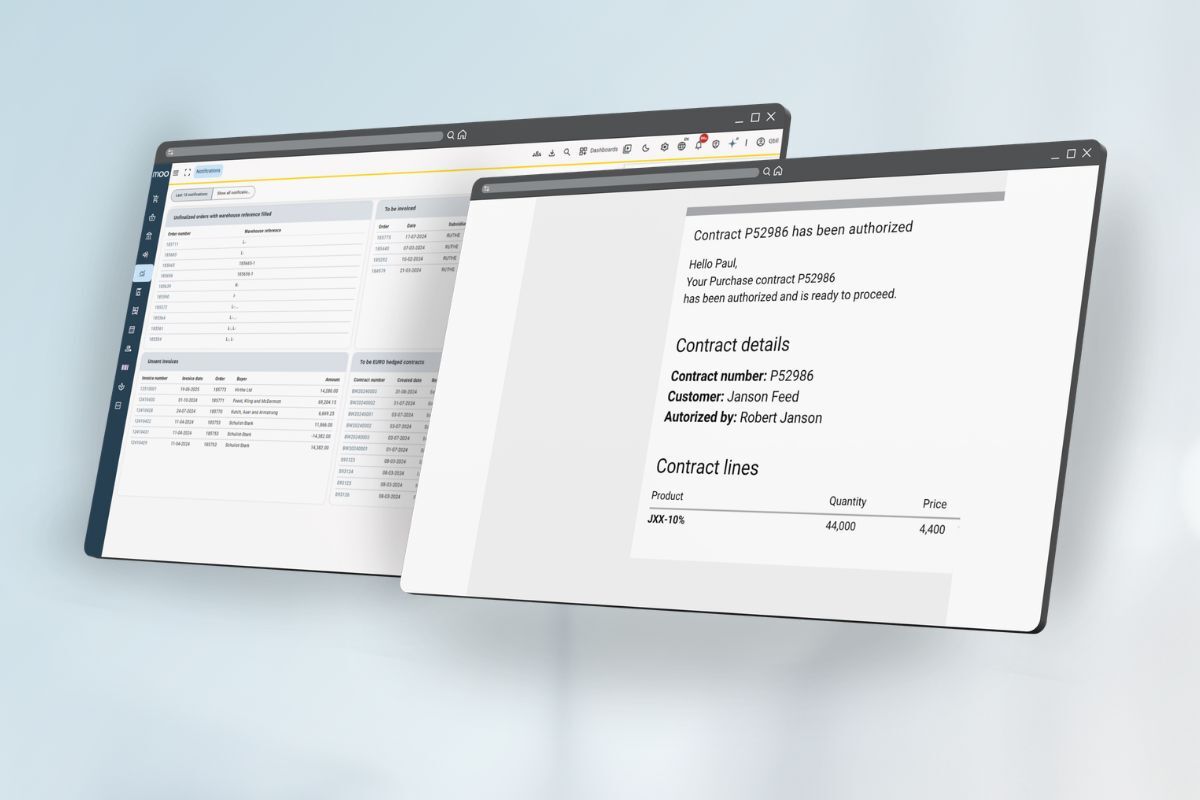
A connected system that links contracts to orders, logistics, and financials removes that gap entirely. With Moo Software’s ERP for dairy trading, every contract update flows through to the relevant downstream steps automatically, so nothing falls through the cracks simply because someone forgot to copy a value from one file to another.
How many versions of ‘the truth’ does a spreadsheet create?
In a typical small dairy trading operation, a spreadsheet creates as many versions of the truth as there are people using it. When two colleagues maintain their own copies of a contract overview, or when a file is emailed back and forth with local edits on each side, the business no longer has one source of data — it has several competing ones. Nobody can say with confidence which version is current.
This is one of the most underestimated problems in the Excel vs trading software debate. The issue is not that spreadsheets are inaccurate by design — it is that they are static by design. A spreadsheet captures a moment in time. The moment someone else opens a different copy and makes a change, the two files diverge. In a multi-person trading operation, that divergence happens constantly.
The practical impact is subtle but damaging. People stop fully trusting the data. They start double-checking figures with colleagues verbally before acting on them. Decisions slow down. Meetings get longer. And occasionally, two people act on two different versions of the same number, creating a real operational error that could have been avoided entirely.
A cloud-based system with a single shared data environment eliminates version conflict by design. Everyone sees the same record, updated in real time, with no email attachments or manual syncing required.
Why does real-time position visibility matter in dairy trading?
Real-time position visibility matters in dairy trading because your exposure changes with every contract you book, every shipment you confirm, and every price movement in the market. If your position overview is even a few hours out of date, you may be taking on risk you cannot see, or missing a hedging opportunity that closes before your spreadsheet catches up.
Position management in dairy ingredient trading is not a back-office reporting task — it is an active, intraday operational need. A trader who does not know their current open position in whey powder or butter cannot make a confident decision about whether to buy, sell, or hold. Waiting until the end of the day to update a spreadsheet is not a workflow choice — it is a structural delay built into the tool itself.
The comparison between Excel and trading software becomes most stark here. A spreadsheet requires someone to manually enter each transaction, recalculate totals, and distribute the updated file before anyone else can see the change. A purpose-built trading system updates positions automatically as contracts and orders are entered, giving every user in the business a live view of where they stand at any moment.
For companies trading across multiple product categories — milk powder, proteins, butter, cheese — the complexity multiplies quickly. Managing those positions manually across multiple sheets is not just inefficient; it is genuinely unreliable at scale.
What does a dairy trader actually lose in time each week?
A dairy trader working from spreadsheets typically loses several hours each week to tasks that a connected system would handle automatically. The time does not disappear in one obvious block — it leaks out in small increments across the day: re-entering data from an email into a sheet, chasing a colleague for the latest version of a file, manually reconciling a contract against an invoice, or rebuilding a position overview that should already exist.
These tasks feel like normal work because they have always been part of the job. But they are not value-adding activities — they are maintenance work created by the limitations of the tool. Every hour spent copying data between files is an hour not spent on sourcing, negotiating, or building customer relationships.
The cumulative effect over a week, a month, and a year is significant. In a five-person trading team, even one hour of avoidable admin per person per day adds up to more than a thousand hours of lost productive capacity annually. That is time that could go toward growing the business instead of managing the infrastructure holding it together.
The shift from spreadsheet management to a system designed for ingredient trading does not just save time on individual tasks — it changes the operational rhythm of the business. Processes that required coordination between three people and two files can happen in a single step, with the system handling the downstream updates automatically.
When does spreadsheet management become a business risk?
Spreadsheet management becomes a genuine business risk when the complexity of your trading operation outgrows what a static file can reliably track. That threshold is different for every business, but common warning signs include: contracts being missed or duplicated, position overviews that nobody fully trusts, invoicing errors that only surface after payment, and key operational knowledge living in one person’s files rather than a shared system.
The risk is not just operational — it is also structural. When critical business data lives in spreadsheets on one person’s laptop, that data is one resignation, one hardware failure, or one accidental deletion away from being lost. In a regulated trading environment, the inability to produce accurate records quickly is not just inconvenient; it can create compliance problems.
There is also a growth ceiling built into spreadsheet-based operations. A business that manages ten contracts a month with two people can function on Excel. The same business managing fifty contracts a month with five people, across multiple product categories and international counterparties, cannot. The tool does not scale with the business — and at some point, the workarounds required to make it function become more expensive than switching to something designed for the job.
The good news is that moving to a purpose-built system does not have to be a long or disruptive process. Get in touch with us to find out how quickly your operation can be running on a system that was actually built for the way dairy ingredient trading works — with your environment fully operational within two days.
Preguntas frecuentes
How do I know if my trading operation has already outgrown spreadsheets?
The clearest signs are behavioural rather than technical: if your team regularly double-checks figures verbally before acting on them, if you've had at least one contract error or missed deadline in the past six months, or if position overviews are only updated at the end of the day, your operation has likely already outgrown what spreadsheets can reliably support. Other red flags include key data living in one person's files, invoicing discrepancies that surface after payment, and staff spending more than an hour a day on manual data entry or reconciliation. If two or more of these apply, the risk of staying on spreadsheets is already higher than the cost of switching.
What does the transition from spreadsheets to a purpose-built trading system actually look like in practice?
For most small dairy trading operations, the transition is significantly less disruptive than anticipated. A system like Moo Software's ERP is designed specifically for dairy ingredient trading, which means the data structures, workflows, and terminology already match how your business operates — you're not adapting a generic tool to fit your processes. In practical terms, your existing contract and counterparty data is migrated into the new system, your team is walked through the core workflows, and the environment can be fully operational within two days. The bigger adjustment is cultural: shifting from a habit of managing data manually to trusting a connected system to handle downstream updates automatically.
Can a small dairy trading company with just two or three people justify the investment in trading software?
Yes, and often more easily than larger operations, because the time savings are felt immediately and proportionally. In a two-person team, each individual is typically carrying a disproportionate admin burden — maintaining multiple spreadsheets, chasing updates, and manually reconciling data across files. Eliminating even two hours of that work per person per week frees up meaningful capacity in a small team. Beyond time, the risk reduction argument is particularly relevant for small operations: when critical business data lives in one person's files, a single resignation or hardware failure can cause serious disruption. A shared, cloud-based system removes that single point of failure from day one.
What happens to historical contract data and records when switching to a new system?
Historical data migration is a standard part of the onboarding process and does not require you to start from scratch or maintain parallel systems. Existing contract records, counterparty details, and open positions can be brought into the new system so that your team has continuity of information from the moment they go live. It's worth auditing your spreadsheet data before migration to identify and resolve any inconsistencies — duplicate entries, missing fields, or conflicting figures — since migrating clean data leads to a much smoother transition. Your implementation team should guide you through exactly what data is needed and in what format.
How does purpose-built trading software handle the complexity of trading across multiple dairy product categories simultaneously?
A purpose-built system manages multi-product complexity by maintaining separate but connected position overviews for each product category — whey powder, butter, milk powder, proteins, cheese — while also giving you a consolidated view of your total exposure across all categories at once. This is something spreadsheets structurally cannot do reliably, because keeping multiple product sheets synchronised in real time requires constant manual effort and introduces version risk at every step. In a connected trading system, entering a contract for one product automatically updates the relevant position, links to the corresponding logistics and invoicing workflows, and remains visible to every user simultaneously — regardless of how many product categories are active at the same time.
What are the most common mistakes dairy traders make when trying to fix spreadsheet problems with more spreadsheets?
The most common mistake is adding complexity to a tool that is already at its limit — building more elaborate formulas, adding validation rules, or creating a 'master sheet' that others are supposed to update. These solutions address symptoms rather than the underlying structural problem, which is that spreadsheets are static, siloed, and not designed for multi-user real-time operations. Another frequent mistake is assuming that stricter manual processes (naming conventions, version control rules, update schedules) can compensate for what the tool cannot do by design. They can reduce errors temporarily, but they add process overhead and still fail when someone is busy, absent, or simply forgets. The energy spent maintaining those workarounds is almost always better invested in a system that handles those controls automatically.
Is there a compliance or audit risk specific to spreadsheet-based trading records?
Yes, and it is one that is easy to underestimate until it becomes urgent. Spreadsheet records are inherently difficult to audit because they lack a reliable change log — it is rarely possible to prove who changed a figure, when, and why. In a regulated trading environment, or in a dispute with a counterparty, the inability to produce a clear, timestamped record of contract terms and amendments can create serious legal and commercial exposure. Purpose-built trading systems maintain a full audit trail by default, recording every change to a contract or order with a timestamp and user attribution. That audit trail is not just a compliance safeguard — it is also a practical tool for resolving internal disagreements about what was agreed and when.